Q.01
Can a slab leak cause mold in Gilbert?
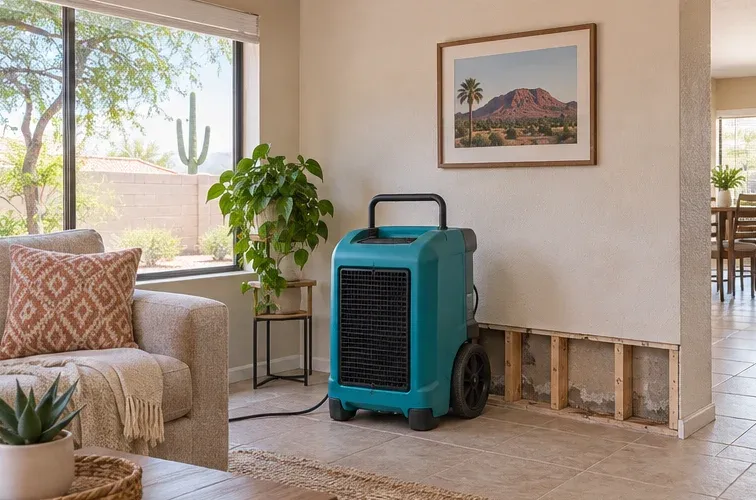
Yes. Water from a line under the slab wicks up through the concrete and wets carpet, baseboard and drywall. The mold can appear a room away from the failed pipe.
Service area · Gilbert, AZ
You found mold or a stain in Gilbert. Send the form day or night, and someone from our team will call you back soon. We serve Gilbert and the towns around it.
Form open 24/7
Get a call back
Tempe · Maple-Ash · Mitchell Park · Escalante · University Park · Riverside + 29 more towns
Gilbert grew up fast and almost all at once, so its mold problems come from cooling systems and from pipes under the floor rather than from old attics.
Mold removal in Gilbert starts with a short list of suspects. Only 4.1 percent of Gilbert homes were built before 1980 (ACS 2024 5-year), so old plumbing and old roof decks are rare. What the town has instead is a large stock of houses built after 1980, each with an air handler, a condensate line and a water supply running under a slab. When mold shows up in a Gilbert house, the cause is usually one of those three, and the visible growth is at the end of a path that started somewhere else.
Gilbert has 280,262 residents, and 26.9 percent of occupied homes are rented (ACS 2024 5-year), a lower renter share than Phoenix, Mesa, Chandler or Scottsdale. Most occupied homes are owner occupied (73.1 percent, ACS 2024 5-year), which changes the conversation: the person paying for the repair also controls the decision about how far the investigation goes.
01 / Good to know
The median owner-occupied value is $575,100 (ACS 2024 5-year), and 12.6 percent of units sit in buildings with 5 or more units (ACS 2024 5-year). Gilbert is overwhelmingly detached housing. That matters because a detached house has no shared wall to blame. The water has to come from the roof, the mechanical closet or the ground under the floor.
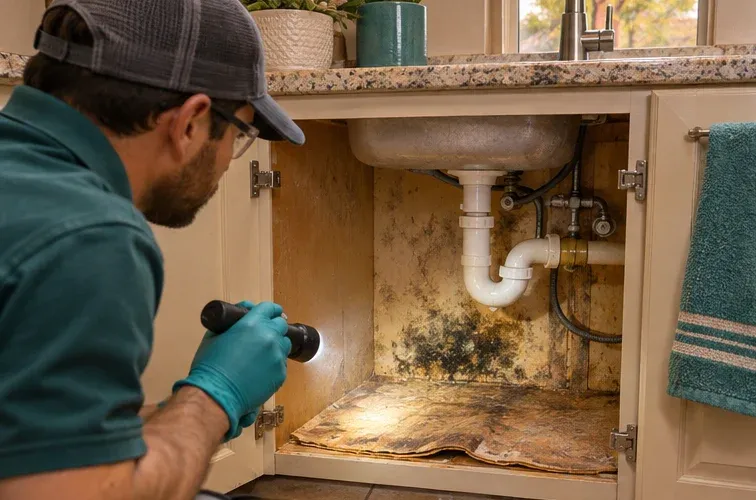
The failures are rarely about worn-out materials. 3 patterns repeat:
02 / Good to know
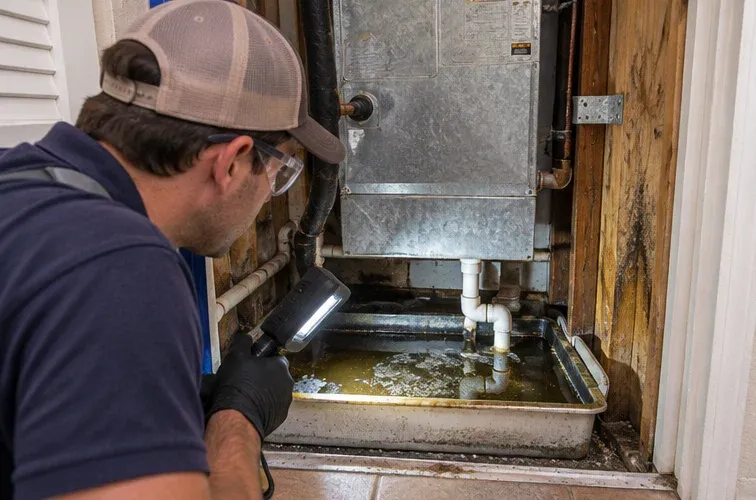
An air handler removes a large volume of water from the air every day of the cooling season, and it leaves through a small drain line. Algae, dust and insect debris narrow it over time, and one hot week is enough to finish the job.
The first sign is often not mold. It is a damp patch on the closet floor, a rust line on the pan, or a stain on the ceiling below. If the unit sits in the attic, the water soaks insulation and ceiling drywall before anyone notices. The AC mold page explains how the growth follows the pan and the plenum.
03 / Local risk
A slab leak is a failure in a water line buried under the concrete floor. In a house built after 1980, the line may be copper or a plastic product, and either can fail at a fitting or a bend. The water does not always surface. It can travel through the soil under the slab, wick into the concrete, and rise into the flooring above.
What follows is a slow, warm, hidden wet patch. Carpet feels damp in one spot, baseboard paint bubbles, and a musty smell appears in a room with no bathroom nearby. A hot spot may show on the floor above the leaking hot line.
Mold here is a symptom. Removing drywall without finding the slab leak only buys time. The water damage page covers the drying that follows the repair.
04 / 5 steps
05 / Costs
National ranges, not local bids. Slab access and floor replacement are separate costs.
| Scope | National range |
|---|---|
| Inspection | $300 to $1,000 |
| Testing, when needed | $250 to $500 |
| Small bathroom | $500 to $1,500 |
| Typical remediation | $1,500 to $9,000 |
| Walls and ceilings | $1,000 to $12,000 |
| Whole home | $10,000 to $30,000 |
Remediation averages about $3,500 nationally, or $10 to $30 per square foot. The lower end fits a closet or a single wall. The upper end fits a room with wet drywall on two sides and a slab repair that has to finish before drying can be verified.
06 / Good to know
Gilbert's renter share is lower than Phoenix, Mesa, Chandler and Scottsdale, but 26.9 percent of occupied homes is still a large number of leases. A.R.S. 33-1324 requires the landlord to keep the premises fit and habitable, and the word mold does not appear in the statute. The general duty still applies.
Put the report in writing. Note the date, the room, what you see and what you smell. Photograph the area before cleaning anything, and keep a copy of the notice. If the source is a slab leak, report the symptom you can observe, such as a warm spot or a damp carpet, rather than a diagnosis you are not qualified to make.
Local numbers
ACS 2024 5-year estimates, as stated in the page text above
Guides for Gilbert
Service area map
Gilbert and the areas around Tempe
The map shows Gilbert and our address in Tempe. The buttons under it open each area page.
All areas07 / 5 questions
Q.01
Yes. Water from a line under the slab wicks up through the concrete and wets carpet, baseboard and drywall. The mold can appear a room away from the failed pipe.
Q.02
Common signs are a warm spot on the floor, running water noise when every fixture is off, a water bill that jumps, and damp carpet in one area. A plumber or leak detection specialist confirms it.
Q.03
Expect $1,500 to $9,000 for remediation nationally, with an average near $3,500 and a per-square-foot range of $10 to $30. Inspection adds $300 to $1,000 (national cost guides). Slab access and floor repair are separate costs.
Q.04
Usually not. The EPA notes that sampling is unnecessary when visible mold is present, and there is no federal health-based standard for mold or spores. Testing is worth it when the source is hidden or two parties disagree about the scope.
Q.05
The EPA advises drying water-damaged areas and items within 24 to 48 hours. A carpet that stays damp over a weekend is worth attention.
08 / Keep reading
Form open 24/7
Get a call back about mold in your home
Send the form. Someone from our team will call you back soon.