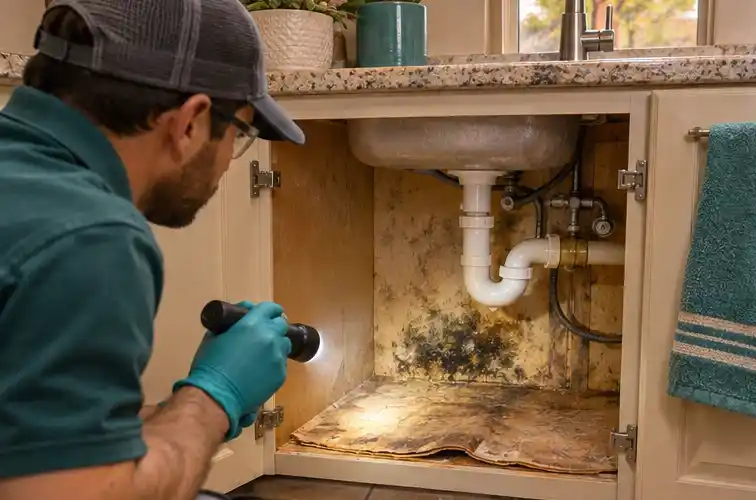
Man in a teal polo shining a flashlight at dark mold on the floor of an under-sink cabinet, a teal striped towel hanging at the right

Service area · San Tan Valley, AZ

Mold Remediation San Tan Valley, AZ

You found mold or a stain in San Tan Valley. Send the form day or night, and someone from our team will call you back soon. We serve San Tan Valley and the towns around it.

Form open 24/7

Get a call back

Tempe · Maple-Ash · Mitchell Park · Escalante · University Park · Riverside + 29 more towns

San Tan Valley was built fast and recently. Its mold problems tend to start in the AC closet or at a roof detail, not in old plumbing.

Mold removal in San Tan Valley follows a young housing pattern. Only 2.5 percent of the housing stock was built before 1980, per ACS 2024 5-year estimates, and the Census reports 0.0 percent of units in buildings with five or more. Almost every home is a detached house. The renter share is 17.8 percent, higher than several neighboring suburbs, so owners and tenants both end up asking the same question: why is a relatively new house growing mold?

The answer is usually water that went unnoticed. San Tan Valley homes run air conditioning for most of the year, and the condensate line is a common failure point. Roof details are another. Old pipes are rarely the story.

If growth is visible, the next step is an inspection that traces the moisture, not a cleaning price given over the phone. Fix the source, contain the area, remove what cannot be cleaned, and dry the structure.
01 / Good to know

A young community of detached houses

San Tan Valley has 109,189 residents, and the median owner-occupied home value is $410,100. Detached houses dominate and shared walls are few. That rules out some of the moisture paths common in older, denser cities, and it concentrates the risk in three places: the AC system, the roof, and the plumbing inside the walls.

A young house still needs maintenance. A condensate line with a shallow slope can clog within a few summers. A roof flashing installed against a stucco wall can open a gap after a decade of expansion and contraction.

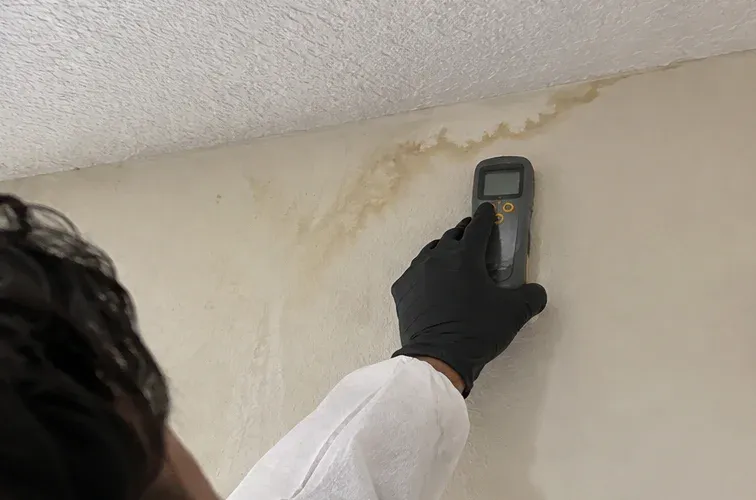
Gloved hand holding a moisture meter against a wall with brown water stains below a textured ceiling

02 / Local risk

The AC system carries most of the moisture risk

A San Tan Valley air handler works through a long cooling season. It pulls water from the air all day, and that water has one way out: the condensate drain. When the line clogs, the pan fills and overflows into the cabinet, the platform, and the drywall nearby.

Four places to look:

  • The drain pan under the indoor coil, for standing water or a rust ring.
  • The condensate line where it exits the unit, for algae or a kink.
  • The secondary drain or float switch, if the system has one, for signs it has tripped.
  • The ceiling below an attic or closet air handler, for a faint ring or a soft spot.

Flexible duct adds another layer. A wet liner inside flex duct can be hard to dry in a hot attic, and cleaning may not solve the problem. Replacement is sometimes the practical answer. The AC mold removal page explains how the air handler, plenum, and duct runs are handled.

The EPA recommends keeping indoor humidity below 60 percent, ideally between 30 and 50 percent.

03 / Monsoon

Monsoon roof details

Monsoon season runs June 15 to September 30. San Tan Valley sits on open ground, and wind driven rain can find any gap: the boot around a plumbing vent, the flashing at a wall, a cracked tile, the edge of a patio cover. Water enters the attic, wets the decking and insulation, and often stops there. The ceiling may stay dry while the sheathing above it stays damp for weeks. A second storm usually finds the same opening, and the damage grows.

Tile roofs are common and generally durable, but the underlayment beneath the tile has a service life. When it fails, water reaches the deck without lifting a tile. A roof inspection after a season of leaks is worth more than another coat of paint on the ceiling. The monsoon roof leak guide covers the sequence from storm to stain.

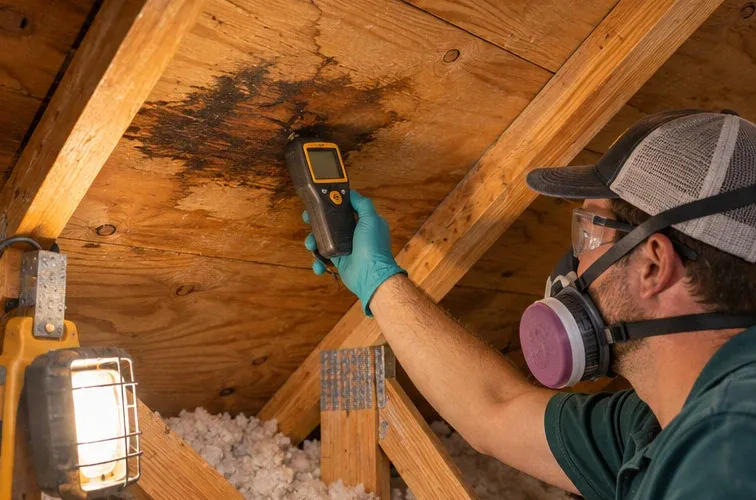
Worker in a respirator and cap holding a moisture meter against dark staining on attic roof sheathing, blown insulation below and a work light at the left

04 / 6 steps

How a San Tan Valley job is scoped

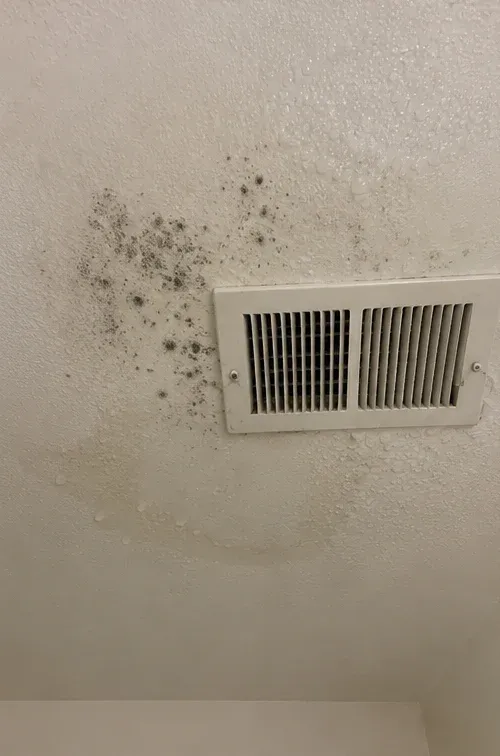
White wall with dark mold spots around a metal floor vent register
  1. Trace the moisture

    The inspection starts at the stain or smell and works backward to the source, with readings and photos.
  2. Hand off the repair

    An HVAC contractor handles the drain line or mechanical work. A roofer handles flashing and tile. The mold scope waits for a dry source.
  3. Build containment

    Plastic barriers and negative air pressure keep the work area separate from the rest of the house.
  4. Remove and clean

    Porous material that stayed wet comes out. Hard surfaces are cleaned and dried.
  5. Dry and verify

    Moisture readings confirm the cavity and framing are dry before closure.
  6. Close the scope

    Reconstruction, paint, and flooring are separate line items.

05 / Good to know

National ranges to budget with

These are national figures, not quotes for a San Tan Valley address.

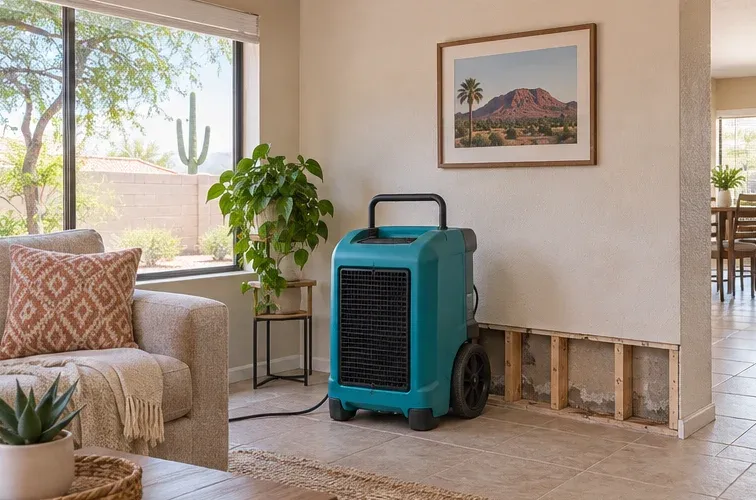
Teal dehumidifier running in a living room with the lower wall opened at the baseboard, a sofa with patterned pillows and a framed desert print
  • 01

    Inspection

    $300 to $1,000 (national cost guides), and testing on its own at $250 to $500.

  • 02

    Typical remediation

    $1,500 to $9,000, average about $3,500.

  • 03

    Per square foot

    $10 to $30.

  • 04

    Attic remediation

    $1,500 to $9,000.

  • 05

    Walls and ceilings

    $1,000 to $12,000.

06 / Good to know

Renting in San Tan Valley

Nearly one in five homes here is rented, and most rentals are houses rather than apartments. That matters because a tenant may be the first person to notice a ceiling stain, while the repair decision belongs to an owner or a property manager who may be out of state.

Report the issue in writing and include photos, dates, and a description of what changed. Ask for the source to be repaired, not just the stain to be painted. Keep copies of every message. A.R.S. 33-1324 requires a landlord to keep the premises fit and habitable, and the statute does not name mold. The rental mold page explains how to build the record. A tenant who reports the stain early gives the owner a chance to fix the roof before the next storm.

Local numbers

San Tan Valley by the numbers

  • Homes rented17.8%
  • Built before 19802.5%of the housing stock was built before 1980
  • In buildings of 5+ units0.0%of units in buildings with five or more
  • Residents109,189

ACS 2024 5-year estimates, as stated in the page text above

07 / 5 questions

Frequently asked questions

Still have a question?

Send the form. Someone from our team will call you back soon.

Get a call back

Q.01

Is mold common in newer San Tan Valley homes?

It happens, usually after a condensate overflow, a roof leak, or a slow supply line leak. The age of the house does not prevent mold. Wet material that stays undried past the 24 to 48 hours the EPA advises can be enough, and newer houses still use paper faced drywall and OSB.

Q.02

How do I know if the AC or the roof is the source?

Watch the timing. A musty smell that starts when the AC runs points at the system. A stain that grows after rain points at the roof. A stain that grows steadily in dry weather suggests a plumbing leak.

Q.03

Do I need testing before remediation?

The EPA says sampling is usually unnecessary when mold is visible, and there is no federal health-based standard for mold or spores. Testing can help document a hidden cavity or confirm that an area was affected, but it is not a substitute for finding the water.

Q.04

How much does remediation cost in San Tan Valley?

National ranges put typical remediation at $1,500 to $9,000, with an average near $3,500. Small contained areas cost less. A roof leak that wet attic insulation and ceiling drywall across several rooms costs more.

Q.05

What should a renter do first?

Send written notice with photos and dates, ask for the moisture source to be repaired, and keep a copy. If the response is slow, a follow up message creates a record of when the issue was reported.

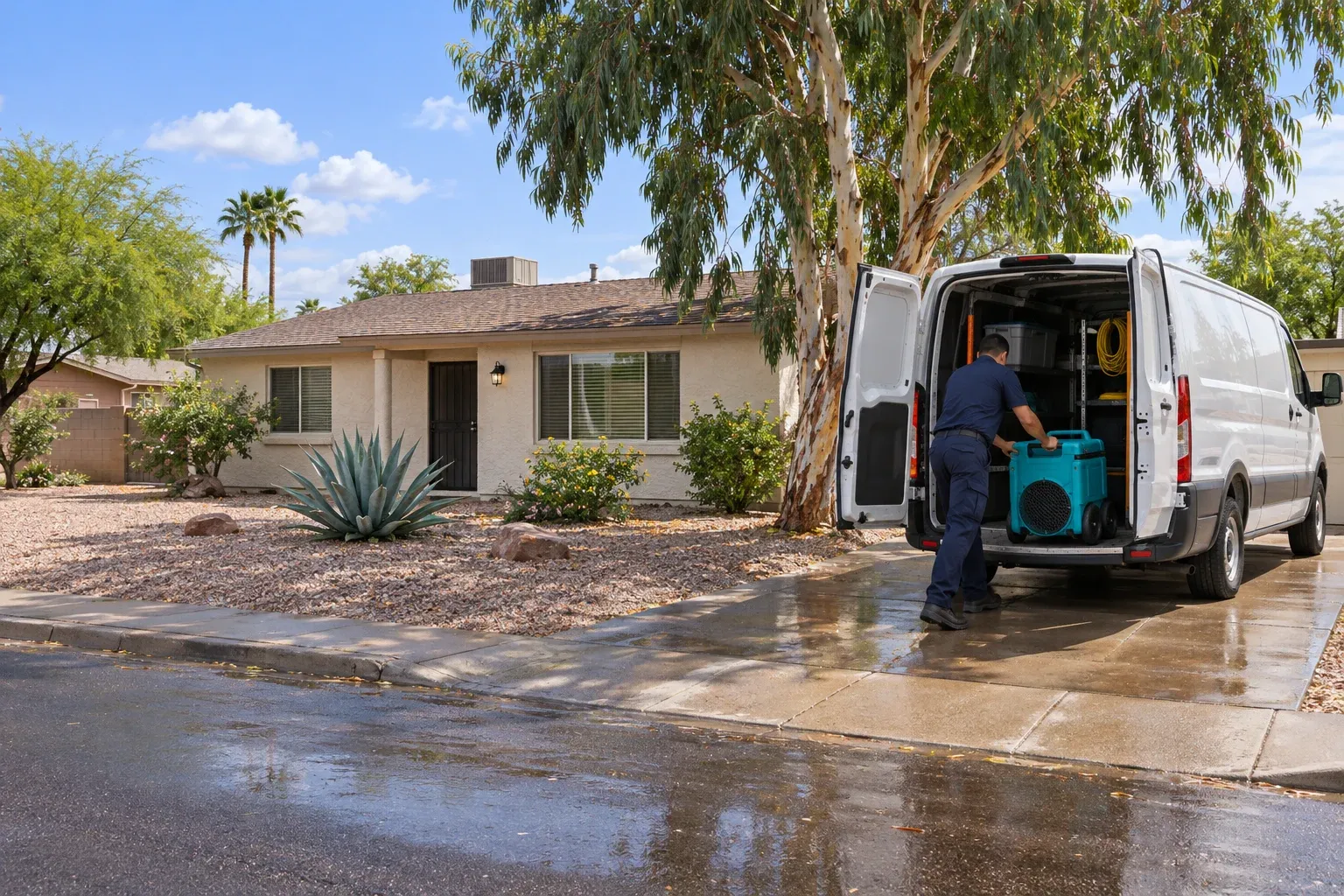
White cargo van with its rear doors open in a driveway, a man in navy work clothes wheeling a teal air machine out in front of a ranch house

Form open 24/7

Get a call back about mold in your home

Send the form. Someone from our team will call you back soon.

Mold in the house?Get a call back

Before you go: want a call back?

Send the request form and someone will call you back about the mold.

Get a call back

Get a call back

Send the form and someone from our team will call you back.