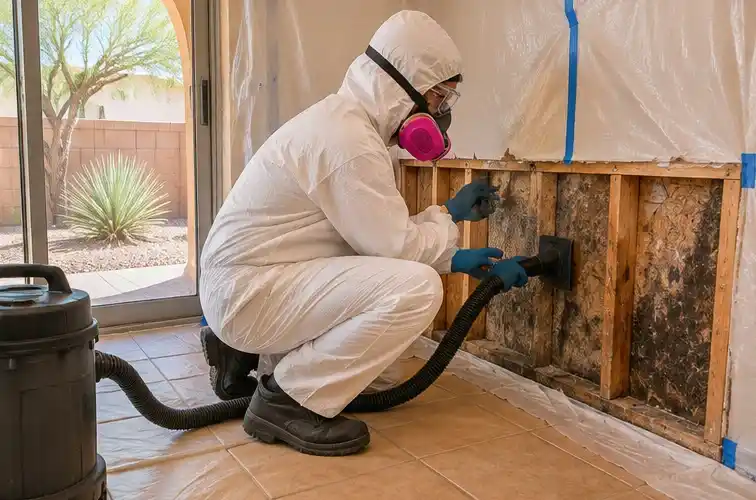
Worker in a white suit and pink respirator vacuuming dark mold from an opened wall cavity beside a sliding glass door, a dark HEPA vacuum at the left

Tempe neighborhood · Mitchell Park

Mold Removal Mitchell Park, Tempe

You found mold or a stain in Mitchell Park. Send the form day or night, and someone from our team will call you back soon. We serve Tempe and the towns around it.

Form open 24/7

Get a call back

Tempe · Maple-Ash · Mitchell Park · Escalante · University Park · Riverside + 29 more towns

Many Mitchell Park addresses share a wall, a roof line or a fan duct with a neighbor. That is where the moisture question starts.

Mold removal in Mitchell Park comes down to one fact: much of the housing shares an assembly with the next address. The neighborhood sits in central Tempe, close to campus, and its blocks mix older single-family houses with small apartment buildings. In the 85281 ZIP code area that covers it, 76.3 percent of occupied units are rented and 33.4 percent of the housing went up before 1980, with 57.6 percent of units inside buildings of 5 or more units, all ACS 2024 5-year figures.

For a tenant or an owner, the first question is not what the growth looks like. It is which side of the wall the water is on. A fan that ends in the attic, a shower pan that weeps into the unit below, or a roof joint shared by two addresses can put growth in a room that never leaked. The next step is a moisture reading at the spot and at the shared assembly behind it, then a written scope that names the source.

01 / Good to know

A neighborhood built in two layers

Mitchell Park mixes 2 kinds of housing. One is a stock of older houses, many later extended, re-roofed or converted to add a bedroom or a bath. The other is small apartment buildings on the same blocks, some with a shared laundry room, water heater or roof.

The two layers fail in different ways. An older house fails at its plumbing and roof penetrations, where a patch or a flashed vent has had decades to work loose. A small apartment building fails at its shared walls and ceiling assemblies, where one unit's bathroom sits against another unit's closet under the same attic. A problem at one address is often a question about the unit next door.

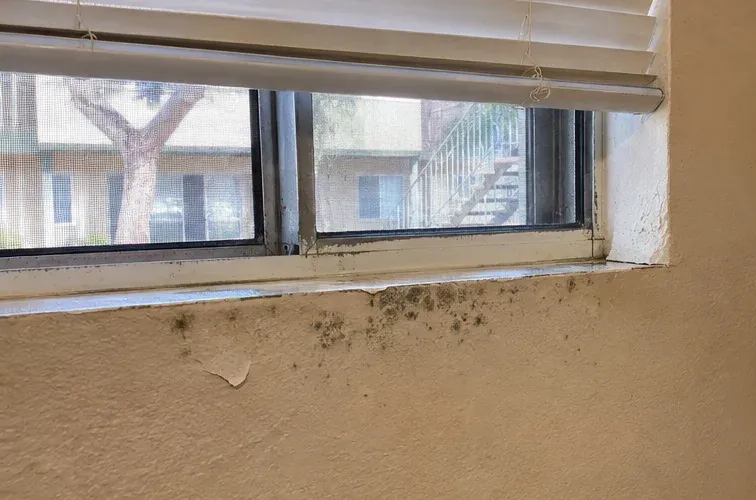
Metal-framed window with peeling paint and dark mold spots on the wall below it, apartment balconies seen through the glass

02 / Good to know

The fan, the wall and the ceiling above

3 paths account for most of the moisture here.

A bathroom fan that stops at the sheathing. The fan clears the mirror but the moisture ends up in the attic instead of outdoors. The ceiling above the bathroom stains first, then the top plate of the wall. In a building with several units, one fan can feed growth over more than one ceiling.

A shared wall with a pipe in it. Supply and drain lines run inside the wall between two units or between a house and an addition. A slow weep keeps the cavity damp for months, and the first sign is usually a smell in the closet on the dry side.

A roof that covers more than one address. Where a porch, an addition or a second unit joins the original roof, water collects at the low side of the tie-in. Monsoon rain from June 15 to September 30 finds those joints every year, and the damage shows up indoors weeks later.

A 4th path belongs to the houses: a water heater in a closet with a failed pan or a corroded fitting. The closet is small, dark and often carpeted.
03 / Good to know

What a first visit looks at

  • Moisture readings at the visible growth, the ceiling above it and the floor below it.
  • The bathroom fan, its duct and where the duct actually ends.
  • The attic sheathing above the wet room, if there is an attic hatch.
  • The shared wall from both sides where access allows, including the neighboring unit.
  • The water heater closet, the supply lines under sinks and the shower pan edges.
  • Roof tie-ins and any patched area visible from the ground or the attic.

The walkthrough is also the point to sort out responsibility. In a building with several units, the repair may belong to an owner, a manager or an association, so the scope should name each item separately for approval.

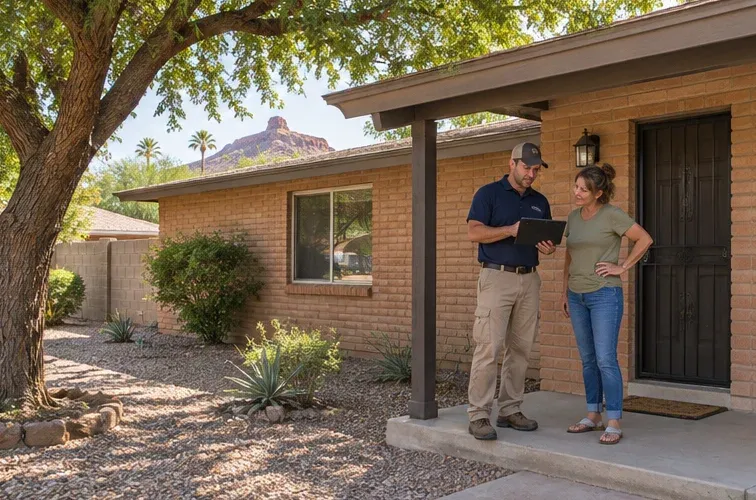
Man in a navy shirt holding a tablet talks with a woman on the walkway of a brick ranch house with a shade tree and a gravel yard

04 / 6 steps

The order of work

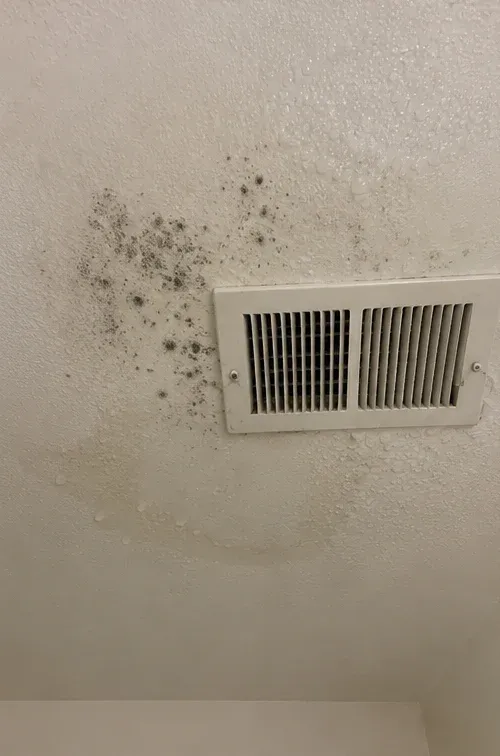
White wall with dark mold spots around a metal floor vent register
  1. Confirm the moisture source and write it down with readings and photos.
  2. Repair the source

    A fan duct, a roof joint, a supply line or a shower pan, whichever the readings point to.
  3. Contain the area with plastic and negative air, especially where a hallway or another unit shares air.
  4. Remove colonized material

    soft drywall, soaked insulation, swollen cabinet board.
  5. Clean and dry the framing and the cavity to a measured reading.
  6. Rebuild, then run the fan and check the attic above within the first month.

Step six is the one that gets skipped. A new ceiling under an old duct stains again by the next monsoon.

05 / Good to know

National ranges to plan with

Costs below are national ranges, not quotes for a Mitchell Park address.

ScopeNational range
Inspection$300 to $1,000
Attic remediation$1,500 to $9,000
Bathroom remediation$500 to $1,500
Walls and ceilings$1,000 to $12,000

A bathroom ceiling with a fan correction lands near the bathroom range. A shared wall opened on both sides, with new drywall in two units, moves toward the walls and ceilings figure. Mold removal inside air ducts runs about $600 to $2,000 nationally.

06 / Property types

For renters and small landlords

A tenant who finds growth should photograph it with something for scale, note the date, and describe the water rather than the color. Send the request in writing and keep a copy. A.R.S. 33-1324 requires the landlord to keep the premises fit and habitable, but the word mold does not appear in it, so a clear description of a leak does more work than a label.

A small landlord should treat every move-out as an inspection window. The unit is empty, the meter reaches the closets, and the attic hatch is easy to open. Catching a fan duct then costs far less than opening a shared wall later.

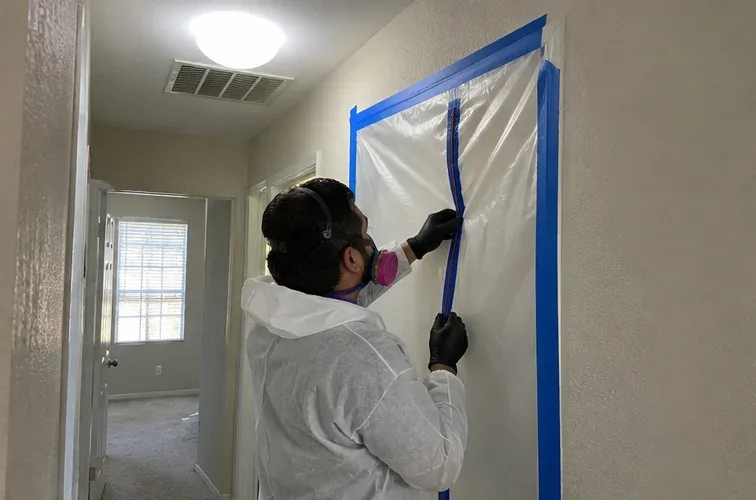
Worker in a white suit and respirator taping plastic sheeting over an apartment doorway with blue tape, a ceiling vent above

Local numbers

Mitchell Park by the numbers

  • ZIP 85281 · Homes rented76.3%of occupied units are rented
  • ZIP 85281 · Built before 198033.4%of the housing went up before 1980
  • ZIP 85281 · In buildings of 5+ units57.6%of units inside buildings of 5 or more units

ACS 2024 5-year estimates, as stated in the page text above

07 / 5 questions

Common questions about shared walls

Still have a question?

Send the form. Someone from our team will call you back soon.

Get a call back

Q.01

How much does mold removal cost in Mitchell Park?

National ranges are about $500 to $1,500 for a bathroom, $1,000 to $12,000 for walls and ceilings, and $1,500 to $9,000 for an attic. An inspection is typically $300 to $1,000 (national cost guides). Shared-wall jobs can involve two units, which is why the scope is written per unit.

Q.02

The growth is in my unit but the leak is next door. What now?

Document your side first: photos, dates and readings if you have them. Then report it in writing to whoever manages the building, naming the adjoining unit as a possible source. Access to that unit is arranged by the owner or manager.

Q.03

Why does the closet smell musty when the bathroom looks clean?

The closet often backs onto the wet wall or sits under the same attic. A fan duct ending at the sheathing or a slow drain weep shows up there first, because a closed closet holds the air.

Q.04

Is a bathroom fan required to vent outside?

It should. A fan that discharges into the attic moves moisture from the bathroom into the roof assembly and concentrates humidity in a closed space. Check where the duct ends before replacing the fan.

Q.05

Can one inspection cover several units?

Often, yes. A building with repeated reports can be walked in one visit, with readings and photos for each unit. That gives a clearer picture of a shared source than separate visits.

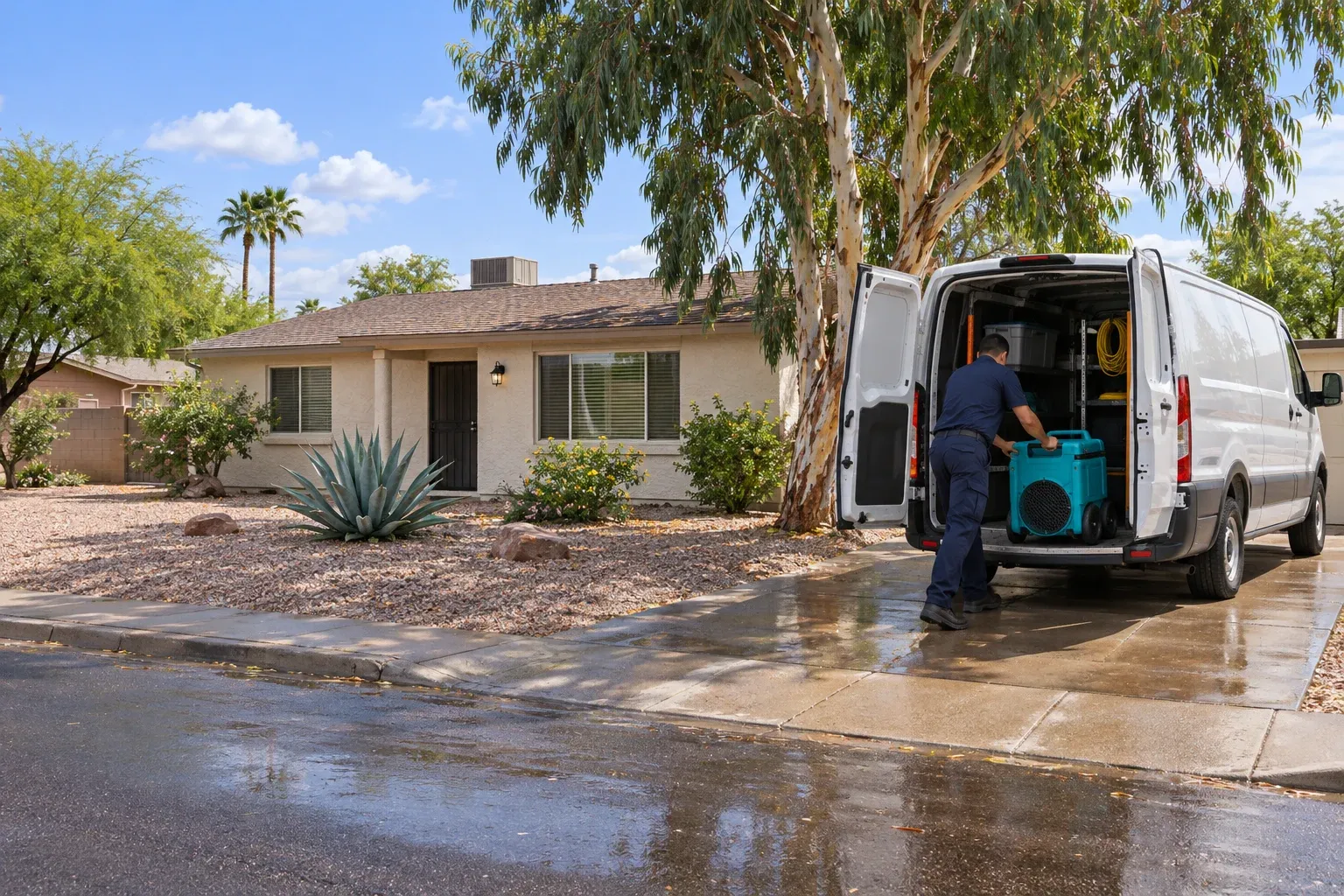
White cargo van with its rear doors open in a driveway, a man in navy work clothes wheeling a teal air machine out in front of a ranch house

Form open 24/7

Get a call back about mold in your home

Send the form. Someone from our team will call you back soon.

Mold in the house?Get a call back

Before you go: want a call back?

Send the request form and someone will call you back about the mold.

Get a call back

Get a call back

Send the form and someone from our team will call you back.