Q.01
Why is mold so common in Glendale apartments?
The city has 25.1 percent of its housing in buildings of five or more units and a 42.8 percent renter share. Shared walls, shared chases and older AC equipment give water more paths between units.
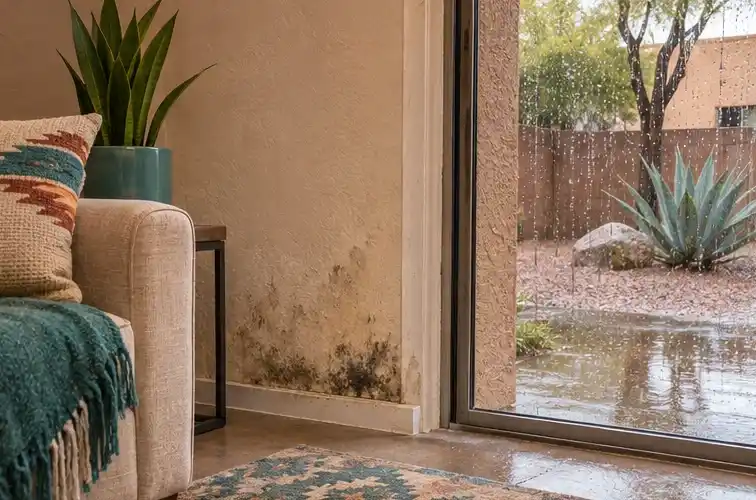
Service area · Glendale, AZ
You found mold or a stain in Glendale. Send the form day or night, and someone from our team will call you back soon. We serve Glendale and the towns around it.
Form open 24/7
Get a call back
Tempe · Maple-Ash · Mitchell Park · Escalante · University Park · Riverside + 29 more towns
Glendale is rental-heavy and old by metro standards: 42.8 percent of homes are rented and 35.4 percent went up before 1980. Most moisture starts in an apartment wall or an AC closet.
Mold removal in Glendale, AZ runs into a housing stock where more than a third of the homes went up before 1980. Glendale has 252,833 residents, 42.8 percent of households rent, 35.4 percent of its housing was built before 1980, and 25.1 percent sits in buildings with five or more units (ACS 2024 5-year). A quarter of the city's housing in multifamily buildings is the number that shapes the work: shared walls, shared plumbing chases, and AC equipment that serves several units from one closet.
The next step is to establish which side of a wall the water is on. In a single-family house that question is simple. In a Glendale apartment building it decides who is responsible, what gets opened, and whether the job is one unit or a run of them.
01 / Good to know
Housing of that age carries a recognizable set of parts. Older galvanized supply pipe can narrow with scale and lose pressure before it leaks. Cast iron drains can crack at a joint. Original shutoff valves can stop closing. Bathroom exhaust fans vent into the attic or straight into a wall cavity instead of outdoors, which pushes warm, wet air into a closed space every shower.
Stucco cracks at corners and around window openings, and a wind-driven rain finds them. Water heaters can sit in closets without a pan, so a failing tank can wet the floor and the drywall behind it. None of this means an older Glendale house is failing. It means the moisture list is longer, and the inspection has more places to look.
02 / Good to know
With 25.1 percent of Glendale housing in buildings of five or more units, a large share of problems begin with a stain that is not on the wall where the water started. A tub overflow in the unit above, a supply line behind a neighboring refrigerator, a condensate line from a rooftop air handler, or a slab leak under an adjacent unit can all surface on the wrong side of a shared wall.
That changes the scope. Mold on a shared wall can mean opening the wall on both sides or working from the wet side with containment, and the property manager should be involved early. A tenant who paints over the stain before the source is fixed is delaying the problem, not solving it. The rental mold page covers the notice sequence, and commercial mold removal covers common areas and buildings with multiple units.
03 / Good to know
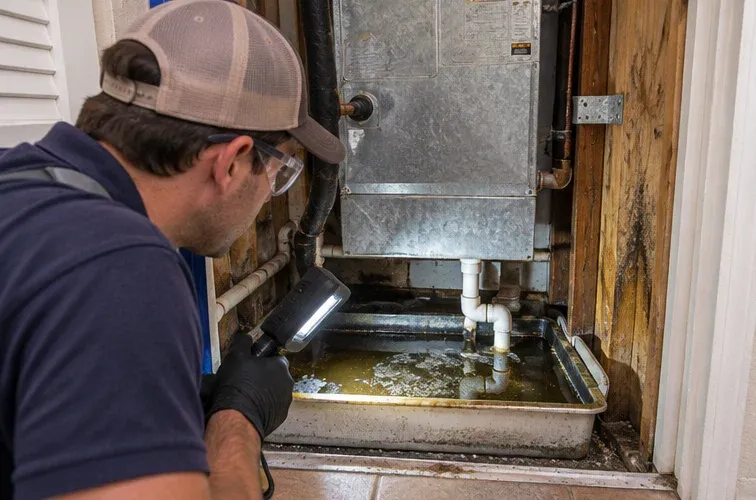
An air conditioner in a Glendale building of that vintage is often a mix of original parts and replacements. The air handler may sit in a closet with a rusted drain pan, a condensate line that empties onto a roof or into a planter, and ductwork that has been patched more than once. When the pan rusts through or the line clogs, water lands on the closet floor and travels down.
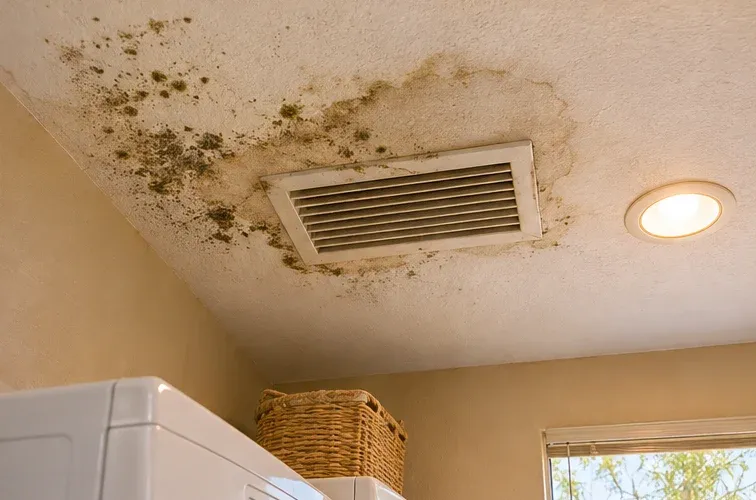
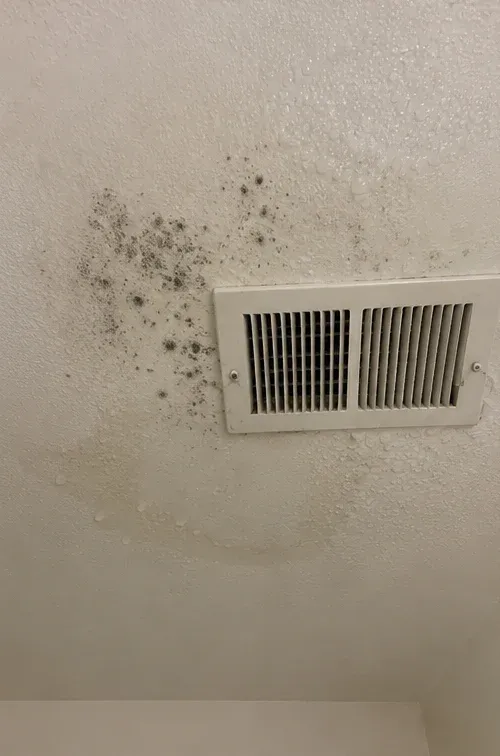
Growth then appears on the cabinet, the plenum, the drywall below the closet, and sometimes on the ceiling of the unit underneath. National HVAC remediation runs $3,000 to $10,000 when the air handler and duct system are affected, and air duct mold removal alone runs $600 to $2,000. Removing mold from vents runs $100 to $500 when the ducts are not affected. Those are national ranges, not Glendale bids.
04 / 6 steps
05 / Costs
These are national ranges from two national cost guides. An apartment bathroom and a whole unit sit at opposite ends of the same table.
| Scope | National range |
|---|---|
| Small bathroom | $500 to $1,500 |
| Walls and ceilings | $1,000 to $12,000 |
| HVAC system and ducts | $3,000 to $10,000 |
| Full remediation | $1,500 to $9,000, average about $3,500 |
A single room with surface growth near the low end is a different job from a wall cavity behind a shower. The written scope is what separates the two.
06 / Good to know
With 42.8 percent of households renting, the tenant is often the person who finds the problem first. Report it in writing, with the date, the location, and photos that include something for scale. Keep a copy. A phone call is easy to lose; a written notice is not.
A.R.S. 33-1324 requires a landlord to keep the premises fit and habitable. The statute does not name mold, so a request is strongest when it describes the water, the leak or the failed component rather than the word alone. When the moisture comes from another unit, ask the manager to inspect both units, since treating one side leaves the source running. This is general information, not legal advice.
Local numbers
ACS 2024 5-year estimates, as stated in the page text above
Guides for Glendale
Service area map
Glendale and the areas around Tempe
The map shows Glendale and our address in Tempe. The buttons under it open each area page.
All areas07 / 5 questions
Q.01
The city has 25.1 percent of its housing in buildings of five or more units and a 42.8 percent renter share. Shared walls, shared chases and older AC equipment give water more paths between units.
Q.02
National ranges run $1,500 to $9,000 for remediation, with an average near $3,500. A small bathroom runs $500 to $1,500, and HVAC work runs $3,000 to $10,000.
Q.03
Often, yes, but not always. A condensate line, a roof detail or a supply line in the wall can produce the same stain. A moisture inspection traces it before anything is opened.
Q.04
A.R.S. 33-1324 requires the premises to be fit and habitable, but the statute does not mention mold by name. Put the request in writing and describe the water or defect.
Q.05
Sometimes. A contained bathroom job usually allows it, while a full unit with containment and drying may not. The scope should state which one applies before work starts.
08 / Keep reading
Form open 24/7
Get a call back about mold in your home
Send the form. Someone from our team will call you back soon.