Q.01
Why are older Scottsdale condos prone to mold?
They combine shared roofs, shared plumbing chases and stacked units. A single failed roof detail or pipe joint can wet several homes, and the moisture often travels before it shows.
Service area · Scottsdale, AZ
You found mold or a stain in Scottsdale. Send the form day or night, and someone from our team will call you back soon. We serve Scottsdale and the towns around it.
Form open 24/7
Get a call back
Tempe · Maple-Ash · Mitchell Park · Escalante · University Park · Riverside + 29 more towns
Scottsdale has two housing stories, and both get wet. Older condos leak through shared walls and common roofs, while newer houses leak at the details nobody sees.
Mold removal in Scottsdale is rarely a single-family problem alone. The city has 243,821 residents, and 29.4 percent of its housing units sit in buildings with five or more units (ACS 2024 5-year), well above the shares in Mesa, Chandler and Gilbert. At the same time, 28.8 percent of Scottsdale homes were built before 1980 (ACS 2024 5-year). Put those numbers together and you get a large stock of older condominiums and attached homes, which can mean flat or low-slope roofs, shared plumbing chases and a homeowners association that controls the roof.
The other half of the city is newer and more expensive. The median owner-occupied value is $789,800 (ACS 2024 5-year). A high price buys better finishes and better locations. It does not buy a roof that never leaks, an air handler that never overflows or a wall that never gets wet. Water behaves the same in an expensive house as in an older condo.
01 / Good to know
Scottsdale's pre-1980 share of 28.8 percent (ACS 2024 5-year) includes older low-rise condo complexes that can share roofs, walls and plumbing. Those buildings can have three features that matter for mold:
The 33.0 percent renter share (ACS 2024 5-year) adds another layer. A tenant may notice the smell first, while the owner and the association decide what happens next.
02 / Good to know
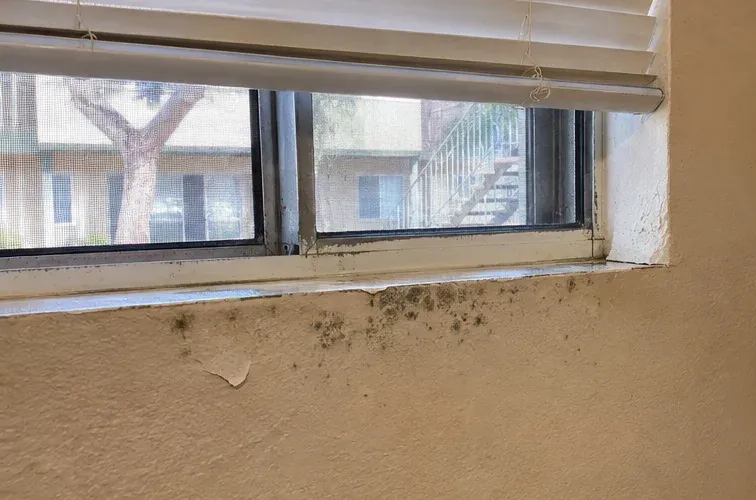
Monsoon roofs. The season runs June 15 to September 30. Flat and low-slope roofs pond at drains and edges, and wind-driven rain pushes under flashing and into roof-to-wall joints. On a condo building, one failed detail can wet several units.
Shared plumbing chases. A supply line or drain in the wall between units can fail without anyone seeing it. Water follows the chase down and shows up as a stain on a ceiling two floors below.
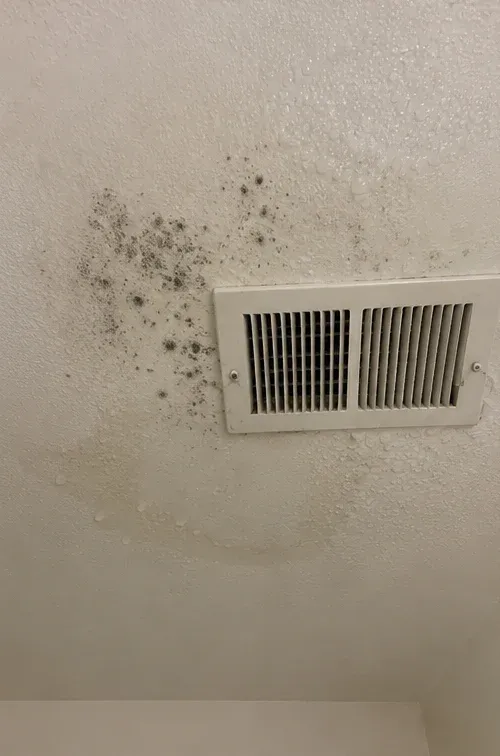
Rooftop and closet air handlers. In older complexes, the air handler may sit in a closet off a hallway or on the roof. A clogged condensate line overflows into the closet, the hallway carpet or the unit below. The AC mold page explains the sequence.
Bathroom vents. A fan that discharges into the attic or the roof cavity adds moisture to the deck all summer. In a low-rise building with a shared attic, that moisture is not confined to one unit.
Irrigation and pool equipment. Common-area irrigation lines, pool pumps and hose bibs sit against walls and in equipment rooms. A slow drip keeps a wall or a slab edge damp for months.
03 / 5 steps
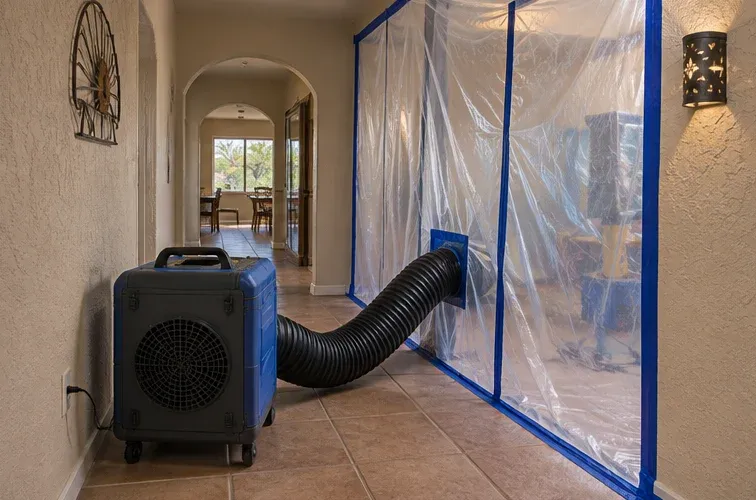
In a shared building, the documentation matters as much as the removal. Photos of the wet boundary and moisture readings before demolition are what an association or an insurer may ask for later.
04 / Costs
These are national ranges, not local quotes. Building access, roof work and the number of units involved move the total more than the square footage alone.
| Scope | National range |
|---|---|
| Inspection | $300 to $1,000 |
| Testing, when needed | $250 to $500 |
| Small bathroom | $500 to $1,500 |
| Typical remediation | $1,500 to $9,000 |
| HVAC system | $3,000 to $10,000 |
| Whole home | $10,000 to $30,000 |
Remediation averages about $3,500 nationally, or $10 to $30 per square foot. A single closet with surface growth is at the low end. A roof leak that wet two ceilings and a shared wall is not, and the roof repair is a separate line item.
05 / Good to know
A.R.S. 33-1324 requires a landlord to keep the premises fit and habitable, and the word mold does not appear in the statute. The duty is general, so the written record carries the argument. Report the problem in writing, photograph it with a date, and keep a copy of every message.
In an association, the declaration and the bylaws define who repairs the roof, the exterior walls and the pipes inside them. Ask for the section that applies before authorizing work, and copy the association on any notice about a leak that starts outside your unit.
A tenant should not order repairs that the lease assigns to the owner. Document, notify, and keep the area dry in the meantime.
Local numbers
ACS 2024 5-year estimates, as stated in the page text above
Guides for Scottsdale
Service area map
Scottsdale and the areas around Tempe
The map shows Scottsdale and our address in Tempe. The buttons under it open each area page.
All areas06 / 5 questions
Q.01
They combine shared roofs, shared plumbing chases and stacked units. A single failed roof detail or pipe joint can wet several homes, and the moisture often travels before it shows.
Q.02
No. Mold needs moisture and material, not a price point. Expensive homes have the same condensate lines, supply lines and roof penetrations, and a leak that is not dried will grow regardless of finish quality.
Q.03
The association usually maintains the common roof, while the owner covers interior finishes. The declaration and bylaws decide the line. Get the answer in writing before work starts.
Q.04
The national range for remediation is $1,500 to $9,000, with an average around $3,500, or $10 to $30 per square foot. Inspection adds $300 to $1,000 (national cost guides), and roof repair is separate.
Q.05
No. AC condensate, supply lines and irrigation drips cause growth year round. Monsoon rain adds the roof and wall leaks that show up between June 15 and September 30.
07 / Keep reading
Form open 24/7
Get a call back about mold in your home
Send the form. Someone from our team will call you back soon.