Q.01
Is Maricopa mostly new housing?
Yes. Only 1.9 percent of the city's housing was built before 1980, according to ACS 2024 5-year figures, and multifamily buildings are a very small share.
Service area · Maricopa, AZ
You found mold or a stain in Maricopa. Send the form day or night, and someone from our team will call you back soon. We serve Maricopa and the towns around it.
Form open 24/7
Get a call back
Tempe · Maple-Ash · Mitchell Park · Escalante · University Park · Riverside + 29 more towns
Maricopa's housing is almost all newer, with only 1.9 percent of homes built before 1980. AC condensate and roof details are common sources of moisture problems.
Mold removal in Maricopa, AZ deals with a housing stock that barely existed before 1980. Maricopa has 67,163 residents, 1.9 percent of its housing was built before 1980, and 0.7 percent sits in buildings with five or more units (ACS 2024 5-year). Almost every home is a detached house of recent construction, and almost none of them have the plumbing failures that come with mid-century buildings.
The moisture list here is short, and it repeats from one house to the next. An AC condensate line clogs. A supply line behind an appliance lets go. A roof detail leaks during a monsoon storm. What makes Maricopa different is how rarely the answer is old pipe, and how often it is a mechanical part that was fine last summer.
01 / Good to know
The median owner-occupied value is $377,200, and 16.4 percent of households rent (ACS 2024 5-year). That rental share is real but modest, and the 0.7 percent multifamily share means apartment buildings are almost absent. Nearly every job is a single-family house with one air handler, one water heater and one roof.
That simplifies the inspection. There are no shared chases to open and no stack of units below to check. The source is usually inside the house or on top of it, and the moisture map covers one structure.
02 / Good to know
The air handler in a Maricopa house is typically in the attic or a garage closet, with the return grille pulling household air across the filter and the coil. Cooling that air produces condensate, and the water leaves through a small drain line. When the line clogs, the pan fills and the overflow goes into the closet floor, the platform and the drywall below.
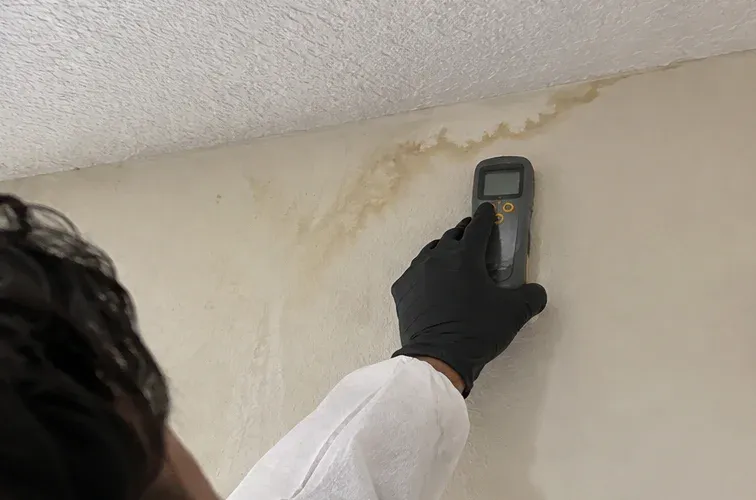
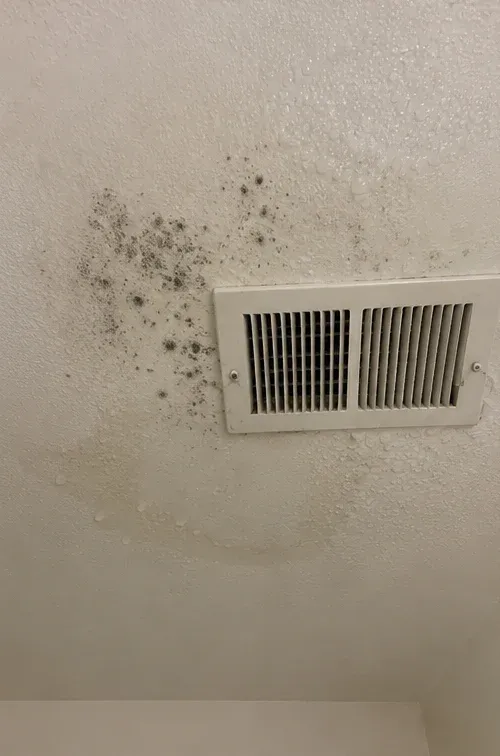
The pattern to watch for: a musty smell at the return when the fan starts, a soft baseboard at the closet door, paint lifting at the corner, or a stain on the ceiling in the hallway under an attic unit. A float switch that shuts the system off is a safety feature, and a house that keeps shutting down in July is telling you the drain is restricted. The EPA range for indoor humidity is 30 to 50 percent, with 60 as the upper limit. When growth reaches the cabinet or the ducts, the AC mold removal page covers that scope.
03 / Good to know
Monsoon rain runs June 15 to September 30, and it finds roof details that a hose test will not. A vent pipe boot cracks in the sun, a valley holds debris, or the flashing at a wall has pulled away. The water reaches the deck, wets the insulation, and shows up as a ceiling stain in a room that may be far from the entry.
Stucco cracks and patio cover tie-ins are the other exterior path. A hairline crack above a window lets wind-driven rain into the wall, and the growth appears on the interior drywall later. Pool equipment and irrigation lines are worth a look as well, since a slow leak at a pump or a valve keeps the wall or the ground beside the house wet.
04 / 6 steps
05 / Costs
These are national ranges from two national cost guides, not quotes for a Maricopa address. Most jobs land somewhere in the remediation range, and the position depends on how much material is wet.
| Scope | National range |
|---|---|
| Inspection | $300 to $1,000 |
| Small bathroom | $500 to $1,500 |
| Remediation | $1,500 to $9,000, average about $3,500 |
| Per square foot | $10 to $30 |
A single closet wall with surface growth is near the low end. A condensate overflow that ran into a hallway ceiling and the wall below moves toward the middle. Room by room figures are on the mold removal cost page.
06 / Good to know
With 16.4 percent of households renting, most Maricopa residents own their homes, but tenants still run into condensate and supply line problems. Report the issue in writing, with photos and a date, and keep a copy of the message and the reply.
Under A.R.S. 33-1324, a landlord has to keep the premises fit and habitable. The word mold is not in the statute, so the notice should describe the wet closet, the leak or the stained ceiling and ask for the source to be fixed along with the damaged material. This is general information, not legal advice.
Local numbers
ACS 2024 5-year estimates, as stated in the page text above
Guides for Maricopa
Service area map
Maricopa and the areas around Tempe
The map shows Maricopa and our address in Tempe. The buttons under it open each area page.
All areas07 / 5 questions
Q.01
Yes. Only 1.9 percent of the city's housing was built before 1980, according to ACS 2024 5-year figures, and multifamily buildings are a very small share.
Q.02
National ranges run $1,500 to $9,000 for remediation, with an average near $3,500, or $10 to $30 per square foot. Inspection adds $300 to $1,000 (national cost guides).
Q.03
Often at the air handler. A clogged condensate line or an overflowing pan wets the closet floor and the drywall and ceiling below it.
Q.04
Yes. Roof details such as vent boots, valleys and wall flashing can leak during the June 15 to September 30 season, even on a newer roof.
Q.05
EPA guidance says a moldy area of less than about 10 square feet can often be handled by the household. Anything larger, or anything tied to an active leak, needs the source repaired first.
08 / Keep reading
Form open 24/7
Get a call back about mold in your home
Send the form. Someone from our team will call you back soon.