Q.01
Does a newer Peoria house need mold testing?
Usually not when the growth is visible. EPA guidance says sampling is generally unnecessary in that case, and no federal health-based standard exists for mold or spores.
Service area · Peoria, AZ
You found mold or a stain in Peoria. Send the form day or night, and someone from our team will call you back soon. We serve Peoria and the towns around it.
Form open 24/7
Get a call back
Tempe · Maple-Ash · Mitchell Park · Escalante · University Park · Riverside + 29 more towns
Peoria is newer than most of the metro, with 9.5 percent of housing built before 1980. That moves the moisture story to AC condensate, supply lines and roof details.
Mold removal in Peoria, AZ rarely begins with a house that is falling apart. Peoria has 196,906 residents, 24.0 percent of households rent, and only 9.5 percent of its housing was built before 1980 (ACS 2024 5-year). A newer house still grows mold. It just grows it in a narrower set of places, and the AC closet sits at the top of the list.
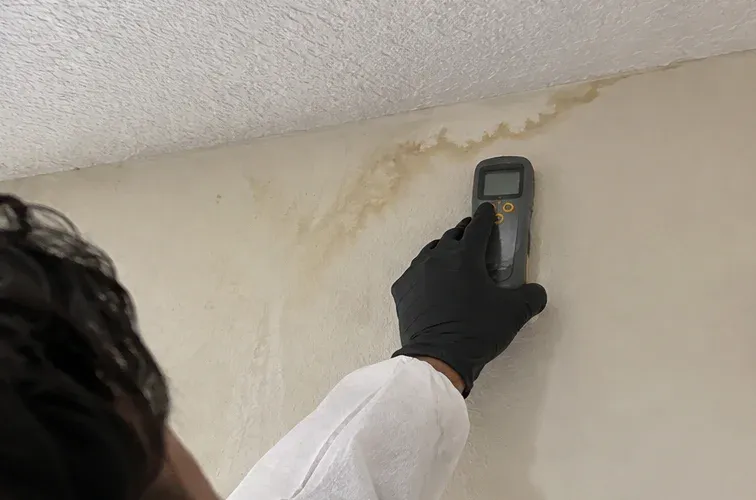
The typical Peoria problem is a stain at the bottom of an air handler closet, a musty smell that arrives with the cooling season, or a soft baseboard beside a water heater. Each one points to a mechanical failure rather than a roof or a half-century-old pipe. The next step is a moisture inspection that confirms the source before any drywall comes out, because cleaning the visible side of a wall while the leak keeps running is wasted work.
01 / Good to know
Only 13.0 percent of Peoria housing sits in buildings with five or more units, and the median owner-occupied value is $463,600 (ACS 2024 5-year). Most of the city is detached housing on subdivision lots, with apartments making up a smaller share than in Glendale or Avondale. That profile removes two common sources at once: shared plumbing chases between units, and the cast iron and galvanized pipe that fails in older neighborhoods.
What remains is a list of failures that have nothing to do with age. A condensate line clogs. A supply line behind a refrigerator or a washing machine lets go. A water heater tank rusts through. A vent boot on the roof cracks after a summer of sun. Any of those can wet a wall for long enough to grow mold in a house that is otherwise in good condition.
02 / Good to know
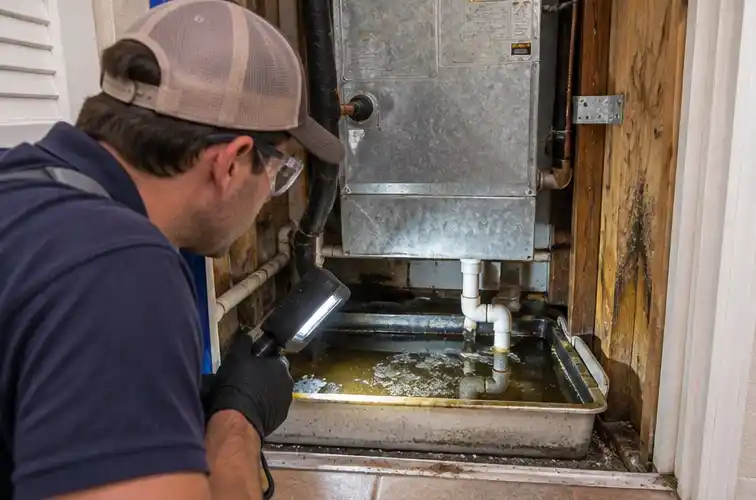
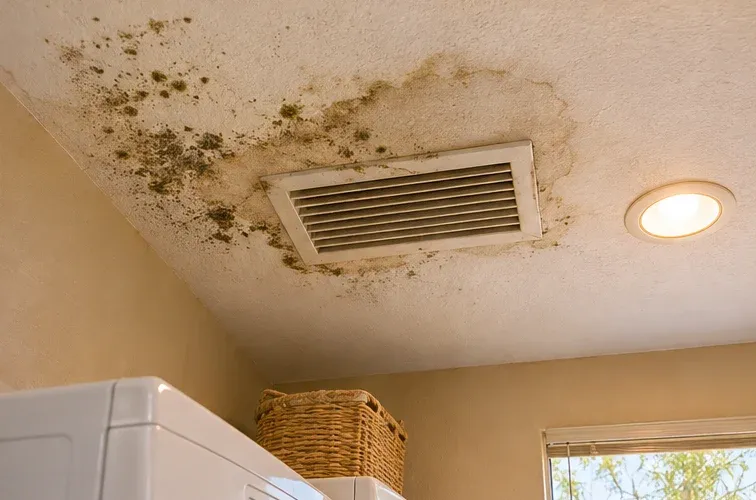
Peoria houses run their air handlers in the attic, a garage closet or a hallway mechanical closet. All summer, the unit pulls water out of the air and sends it down a condensate line. When that line clogs with dust and growth, or when the drain pan has rusted, the water goes somewhere else: the platform, the closet floor, the drywall below, and the ceiling of the room underneath.
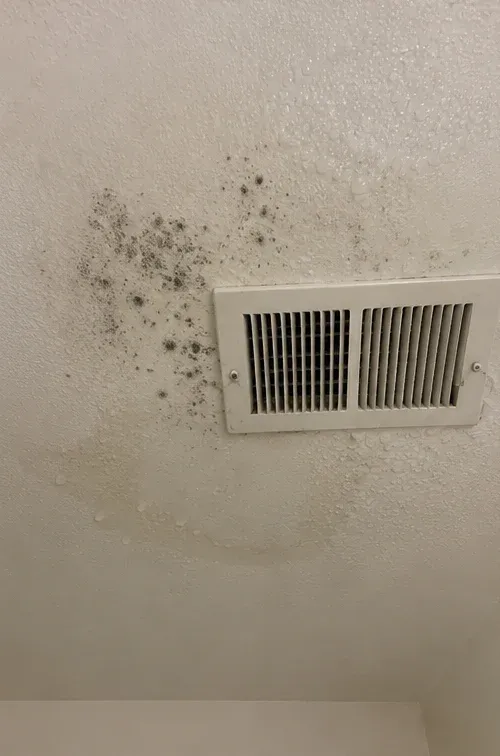
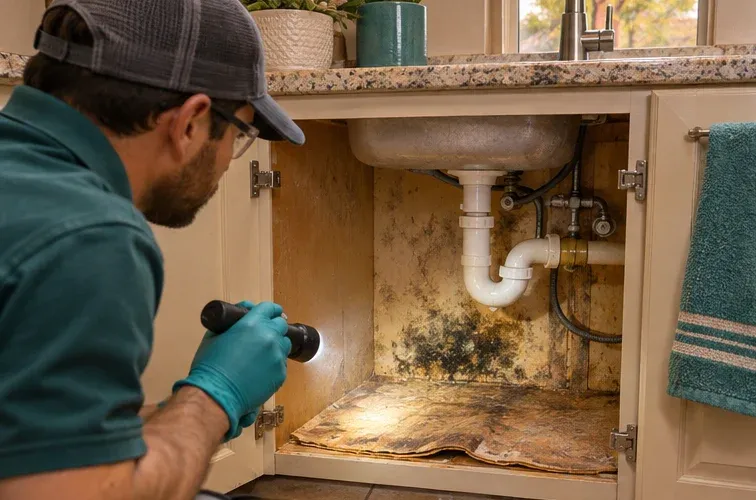
The signs are consistent. Paint bubbles at the base of the closet. The return grille smells musty when the fan starts. The cabinet shows dark streaks near the drain connection. A float switch that shuts the unit off is a good sign, not a bad one, since it stops the water before the drywall does. The EPA target for indoor humidity is 30 to 50 percent, with 60 as the ceiling, and a wet closet can pass that quickly. The AC mold removal page covers the equipment side of the scope.
03 / Sources
Supply lines are another common source. A braided line to a washing machine, a refrigerator ice maker line, or a shutoff valve under a sink can weep for weeks behind a cabinet. The water stays hidden, the cabinet backing swells, and the first visible sign is often a stain on the floor from the other side of the wall.
Water heaters in closets are another. A tank that rusts through, or a temperature and pressure valve that drips, wets the closet floor and the framing behind it. Monsoon rain is a further source, and it tends to show up at a vent boot, a valley or the flashing where an addition meets the original roof. The monsoon season runs June 15 to September 30.
04 / 6 steps
05 / Costs
The numbers below are national ranges from two national cost guides. They are not bids for a Peoria address, and they vary with how much material has to come out.
| Scope | National range |
|---|---|
| Inspection | $300 to $1,000 |
| Remediation | $1,500 to $9,000, average about $3,500 |
| Attic | $1,500 to $9,000 |
| Whole home | $10,000 to $30,000 |
A condensate stain on one closet wall sits near the bottom of the remediation range. A supply line that ran behind a kitchen wall for a month can push a job into the middle or upper end, because cabinets and drywall both come out.
06 / Good to know
Peoria's renter share is 24.0 percent, lower than Glendale or Avondale but high enough that tenants find a good share of the problems. In summer, an AC that stops cooling because the condensate switch tripped is an urgent repair, not a cosmetic one. Report it right away, in writing, and keep the message.
Under A.R.S. 33-1324, a landlord has to keep the premises fit and habitable. The word mold is not in the statute, so describe the water, the leaking line or the failed pan instead. If the fix is scheduled, ask whether the wet material will be dried and checked, not just painted over. This is general information, not legal advice.
Local numbers
ACS 2024 5-year estimates, as stated in the page text above
Guides for Peoria
Service area map
Peoria and the areas around Tempe
The map shows Peoria and our address in Tempe. The buttons under it open each area page.
All areas07 / 5 questions
Q.01
Usually not when the growth is visible. EPA guidance says sampling is generally unnecessary in that case, and no federal health-based standard exists for mold or spores.
Q.02
Budget $1,500 to $9,000 for remediation nationally, average near $3,500, or $10 to $30 per square foot, plus $300 to $1,000 (national cost guides) for an inspection.
Q.03
EPA guidance is to dry water-damaged areas and items within 24 to 48 hours. A condensate line that drips all summer is well past that window.
Q.04
An HVAC contractor handles the line, pan and drain. Remediation follows the repair, since a cleaned closet will wet again if the line still clogs.
Q.05
It happens, mostly where the air handler and ducts sit in the attic. A pan overflow or a sweating plenum wets the platform and the deck nearby.
08 / Keep reading
Form open 24/7
Get a call back about mold in your home
Send the form. Someone from our team will call you back soon.