Q.01
Is Laveen a separate city?
No. Laveen is mostly part of the city of Phoenix, with some unincorporated county land, so the Census figures used here are Phoenix figures.

Service area · Laveen, AZ
You found mold or a stain in Laveen. Send the form day or night, and someone from our team will call you back soon. We serve Laveen and the towns around it.
Form open 24/7
Get a call back
Tempe · Maple-Ash · Mitchell Park · Escalante · University Park · Riverside + 29 more towns
Laveen is not its own Census place, so the housing numbers here are city of Phoenix figures. Most mold work here traces back to a roof detail after monsoon rain.
Mold removal in Laveen, AZ starts with a fact about how the community is counted. Laveen is mostly part of the city of Phoenix, with some unincorporated county land, and it is not a Census place of its own, so there is no Laveen-only housing table. The closest available figures are Phoenix city figures: 1,642,323 residents, 42.7 percent of households renting, and 41.6 percent of homes built before 1980. Those figures describe the whole city, so they are a starting point and not a count of Laveen's own homes.
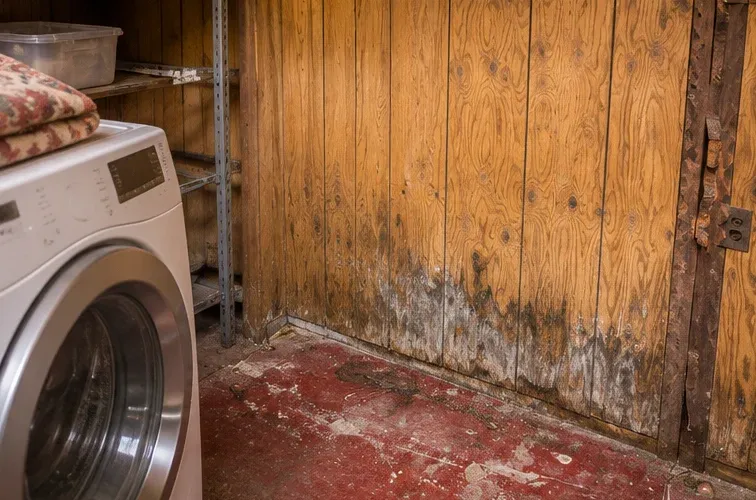
Housing age changes where moisture hides. A newer house rarely fails at rusted galvanized pipe. It fails at a roof transition, a condensate line, or a supply line behind an appliance. The practical first step for an owner or renter here is to find the water source, measure how far the growth has spread, and then decide whether the job is a small bathroom cleanup or a contained removal.
01 / Local facts
The citywide figures are a starting point, not a description of every block. Phoenix reports 26.4 percent of its housing in buildings with five or more units and a median owner-occupied value of $420,700 (ACS 2024 5-year). Parts of Laveen are detached houses on subdivision lots, so the multifamily share of the city may not describe it well. The citywide renter share of 42.7 percent is high enough that rental units show up in much of the mold conversation.
For a homeowner, that means the roof and the HVAC closet matter more than shared plumbing. For a landlord, it means documentation matters as much as the repair. The rental mold page covers that side in more detail.
02 / Monsoon
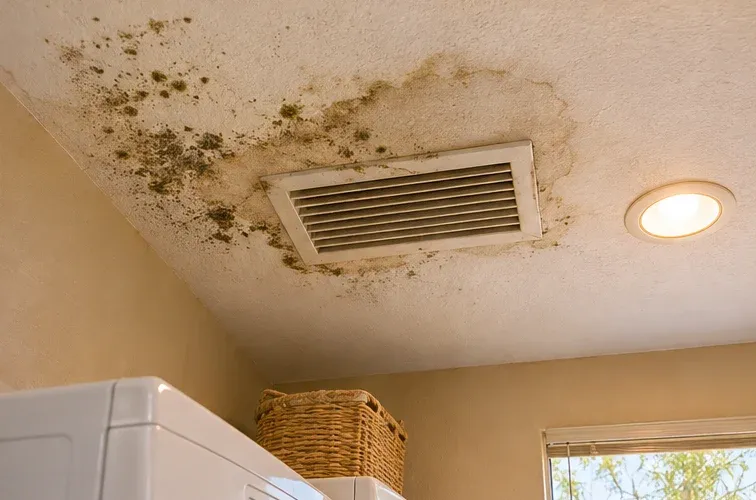
The monsoon runs June 15 to September 30, and the rain arrives with wind behind it. Water that drives sideways finds details a garden hose never touches: vent pipe boots, valley flashing, the transition where a roof meets a wall, and the underlayment under tile. A flat patio cover or a low slope over an addition is another common entry, because water stands there instead of running off.
From the roof, the leak rarely stops at the ceiling. It runs along a rafter, down a wall cavity, and shows up as a stain at a baseboard on the far side of the room. Insulation under the deck holds the moisture and keeps the attic humid for weeks. That is why an inspection looks at the roof, the attic deck and the top plate of the walls together, not just at the visible stain. The attic mold page walks through what removal involves up there.
03 / Good to know
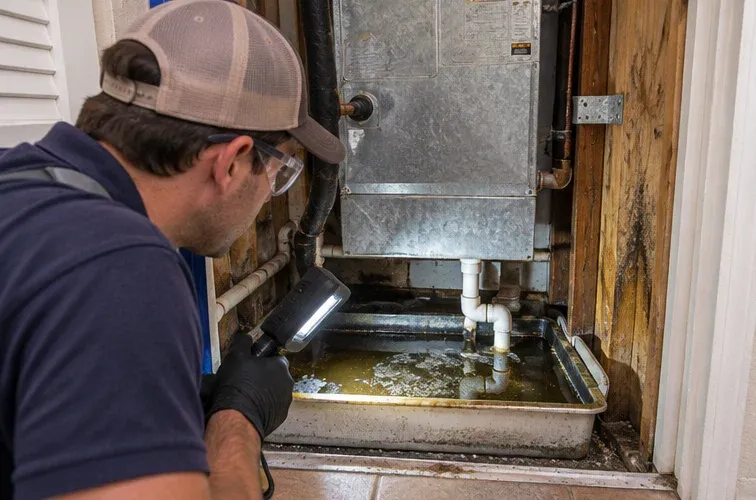
A Phoenix-area house lives on its air conditioner. The air handler sits in the attic, a garage closet or a mechanical room, and it makes water all summer. A clogged condensate line, a rusted drain pan, or a pan that drains to the wrong place wets the platform and the drywall around it. Growth starts on the cabinet, the plenum wrap and the nearby framing. EPA guidance puts ideal indoor humidity at 30 to 50 percent, with 60 percent as the ceiling, and a wet air handler closet can pass that quickly.
04 / 6 steps
05 / Costs
Prices below are national ranges from two national cost guides, not quotes for a Laveen address. A small bathroom job and a whole-house job sit at opposite ends for a reason.
| Item | National range |
|---|---|
| Inspection | $300 to $1,000 |
| Testing | $250 to $500 |
| Remediation | $1,500 to $9,000, average about $3,500 |
| Per square foot | $10 to $30 |
Testing is often unnecessary when the growth is visible, since no federal health-based standard exists for mold or spores.
06 / Good to know
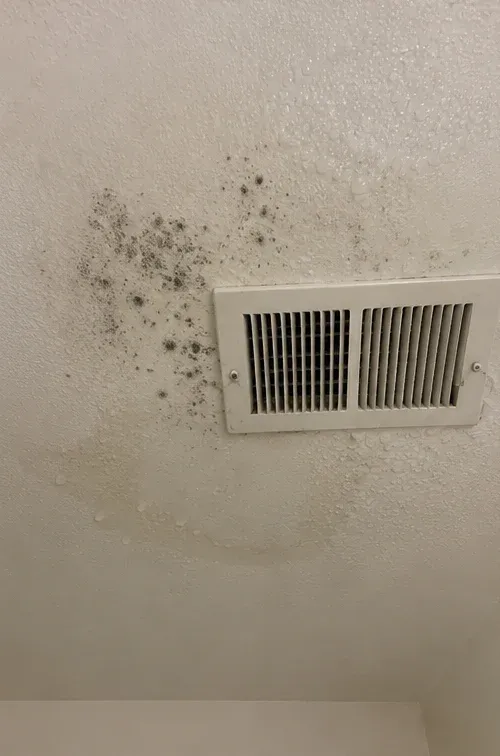
With 42.7 percent of Phoenix households renting, tenants are part of the picture in Laveen too. The sequence that works: photograph the area with something for scale, note the date, report it in writing rather than by phone, and keep a copy. Written notice creates a record that a phone call does not.
Arizona's landlord statute, A.R.S. 33-1324, requires the landlord to keep the premises fit and habitable. The word mold does not appear in the statute, so the argument is about the underlying water or defect, not the word itself. This is general information, not legal advice.
Local numbers
ACS 2024 5-year estimates, as stated in the page text above
Service area map
Laveen and the areas around Tempe
The map shows Laveen and our address in Tempe. The buttons under it open each area page.
All areas07 / 5 questions
Q.01
No. Laveen is mostly part of the city of Phoenix, with some unincorporated county land, so the Census figures used here are Phoenix figures.
Q.02
National ranges run about $1,500 to $9,000 for remediation, with an average near $3,500, or $10 to $30 per square foot. Inspection adds $300 to $1,000 (national cost guides).
Q.03
Yes. Age is not protection. A clogged condensate line, a failed supply line or a roof detail that lets in monsoon rain can wet a newer house just as badly as an old one.
Q.04
A roofing contractor handles the roof. Remediation starts after the roof is closed, because cleaning under an active leak is temporary work.
Q.05
Photograph the area, report it in writing, and keep a copy of the notice. The mold testing page explains when a test adds anything.
08 / Keep reading
Form open 24/7
Get a call back about mold in your home
Send the form. Someone from our team will call you back soon.