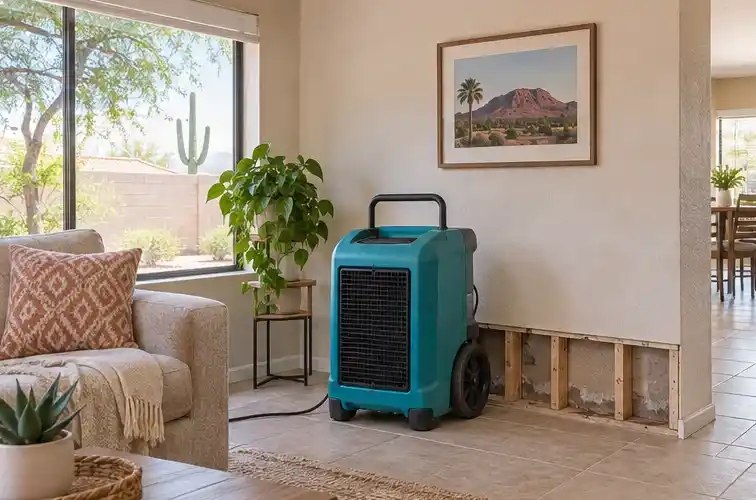
Teal dehumidifier running in a living room with the lower wall opened at the baseboard, a sofa with patterned pillows and a framed desert print

Tempe neighborhood · Meyer-Park

Mold Removal Meyer-Park, Tempe

You found mold or a stain in Meyer-Park. Send the form day or night, and someone from our team will call you back soon. We serve Tempe and the towns around it.

Form open 24/7

Get a call back

Tempe · Maple-Ash · Mitchell Park · Escalante · University Park · Riverside + 29 more towns

Meyer-Park is west-central Tempe, where pre-1980 plumbing and AC closets keep moisture inside the walls long after a leak starts.

Mold removal in Meyer-Park usually traces back to a pipe or a closet that has been in the house since it was built. The neighborhood sits in west-central Tempe, and its housing is older than most of the city's. In the 85282 ZIP code area that covers the neighborhood, 58.1 percent of the housing was built before 1980, 53.0 percent of occupied units are rented, and 34.6 percent of units sit in buildings of 5 or more units, per ACS 2024 5-year figures.

That pre-1980 share is the highest of the 4 main Tempe residential ZIP codes (85281 to 85284), and it points to where moisture hides. Supply and drain lines installed with the house have had decades of repairs, and an AC closet or attic air handler adds a second, slower source. The next step is a reading at the wall behind the cabinet, then at the air handler pan, before anything comes out.
01 / Local risk

Why the pre-1980 share matters

Older houses do not fail all at once. They fail at the joints: a fitting tightened once too often, a drain line patched with a coupling, a valve that no longer shuts off cleanly. Each repair holds until it does not, and the leak that follows is slow enough to look like a stain or a smell.

The 85282 numbers point to a housing stock lived in and worked on for decades. 53.0 percent of occupied units are rented, so a repair may pass through several households before anyone reports it. The median owner-occupied value is $412,000, and 34.6 percent of units are in buildings of 5 or more units, a mix of houses and small complexes.

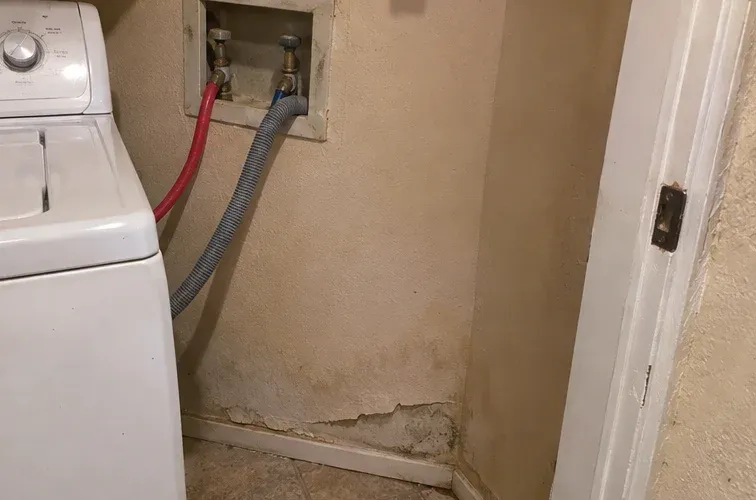
Laundry hookup with red and gray hoses behind a white washer, brown water stains and dark spots on the wall below

02 / Monsoon

Original supply and drain lines

2 kinds of leaks dominate the older houses here.

A supply line that weeps inside a wall. A corroded fitting or a failing valve keeps the cavity damp without a visible drip. The first clues are a musty cabinet, a soft baseboard or paint that bubbles at a seam, not a puddle on the floor.

A drain line that leaks at a joint. Drain water carries more organic material than supply water, so a slow drain leak can feed growth faster. The cabinet under the sink and the wall behind the vanity are the usual first places to show it.

Water heater closets deserve their own line. A dripping valve, a failed pan or a corroded fitting keeps the floor wet in a closet that is small, dark and often carpeted. That is a reliable growth spot in a house this age.

03 / Leaks

AC closets and attic air handlers

An AC closet puts the air handler inside the living space, behind a door, on a platform. The pan and drain line sit in the same small box as the return air, so a clog pours humidity into the air that moves through the house. The closet floor and the wall behind the unit stay damp, and the smell spreads to the next room.

An attic air handler puts the same parts in a hotter space. The equipment runs longer in July, the drain line clogs with dust, and the platform holds moisture against the framing. Torn duct insulation lets cold air meet hot attic air, and the condensation lands on the duct and the platform.

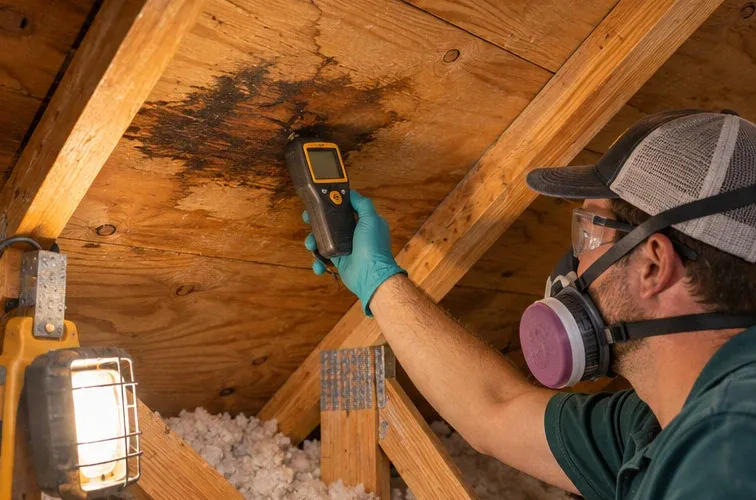
Worker in a respirator and cap holding a moisture meter against dark staining on attic roof sheathing, blown insulation below and a work light at the left

04 / Good to know

What the walkthrough looks for

  • Readings at the cabinet base, the wall behind it and the floor below.
  • Supply and drain lines under every sink and behind the washing machine.
  • The water heater closet, its pan and the fittings above it.
  • The AC closet floor, the air handler pan and the condensate line.
  • The attic platform and the sheathing above the unit.
  • A bathroom fan duct that ends at the sheathing instead of outdoors.

05 / 5 steps

How the job runs

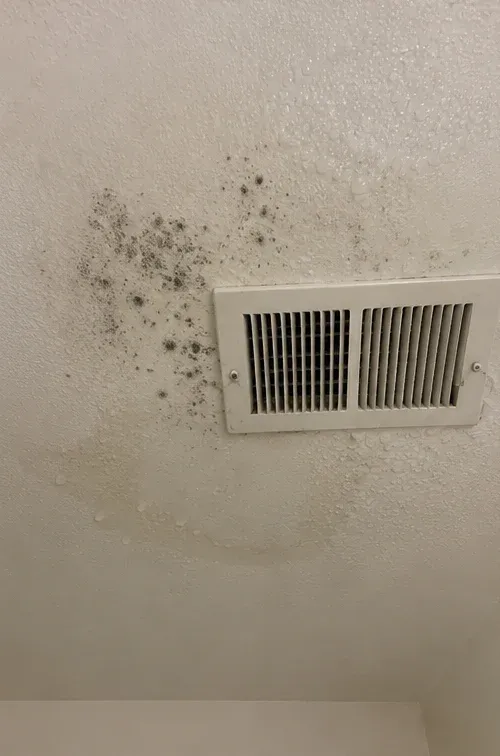
White wall with dark mold spots around a metal floor vent register
  1. Map the water before anything comes out

    Readings at each suspect spot, with photos.
  2. Repair the line, the pan or the duct

    A plumber or HVAC company may handle this step.
  3. Contain the work area, especially when the AC closet shares air with the living space.
  4. Remove soft drywall, swollen cabinet board and wet insulation, then clean the framing.
  5. Dry to a reading, rebuild, and confirm the repair with the system running.

06 / Good to know

National ranges

Figures below are national ranges, not quotes for a Meyer-Park address.

ScopeNational range
Inspection$300 to $1,000
Walls and ceilings$1,000 to $12,000
HVAC and air handler work$3,000 to $10,000
Whole home$10,000 to $30,000

A cabinet base and the wall behind it sits at the low end of the walls range. A supply line that ran for months, with new drywall and cabinet board, moves toward the middle. The whole-home figure applies when several rooms and the duct system are involved.

07 / Good to know

Renting in Meyer-Park

A tenant should put the report in writing, with photos and dates, and describe the water rather than the color of the growth. A cabinet that stays damp after the sink is used, a closet that smells, or a stain that returns after cleaning are all worth naming. A.R.S. 33-1324 requires a landlord to keep the premises fit and habitable, though the statute does not name mold, so the request should ask for the leak to be found and fixed.

An owner with an older house should expect the first repair to reveal a second. A line replaced at one fitting shows the condition of the line beside it, and a scope that stops at the visible stain may miss the next weep.

Local numbers

Meyer-Park by the numbers

  • ZIP 85282 · Homes rented53.0%of occupied units are rented
  • ZIP 85282 · Built before 198058.1%of the housing was built before 1980
  • ZIP 85282 · In buildings of 5+ units34.6%of units sit in buildings of 5 or more units

ACS 2024 5-year estimates, as stated in the page text above

08 / 5 questions

Questions about older plumbing

Still have a question?

Send the form. Someone from our team will call you back soon.

Get a call back

Q.01

How much does mold removal cost in Meyer-Park?

National ranges are about $1,000 to $12,000 for walls and ceilings and $3,000 to $10,000 for HVAC work. An inspection is typically $300 to $1,000 (national cost guides). A cabinet and wall repair sits at the low end.

Q.02

Why does the cabinet under the sink smell musty?

A supply or drain line inside the wall is the usual cause, along with a cabinet base that has absorbed water. Wipe the pipes dry and watch for a new bead of water at a fitting, then have the wall cavity metered before the cabinet is replaced.

Q.03

Is an AC closet a mold risk in this climate?

It can be. The pan, the drain line and the platform sit in a small dark space, and a clog sends water into the closet floor and the wall behind it. Check the pan and the drain line at the start of summer.

Q.04

Does an older house need testing before removal?

Usually not when the growth is visible. The EPA notes that sampling is often unnecessary in that case and that no federal health-based standard exists for mold or spores. Testing helps when the source is hidden or a clearance question needs a number.

Q.05

Can the original plumbing be repaired without opening the wall?

Sometimes a fitting can be reached from a cabinet or a closet. A line that has been weeping inside a wall usually needs the cavity opened to dry it, which is why the removal and the plumbing repair are planned together.

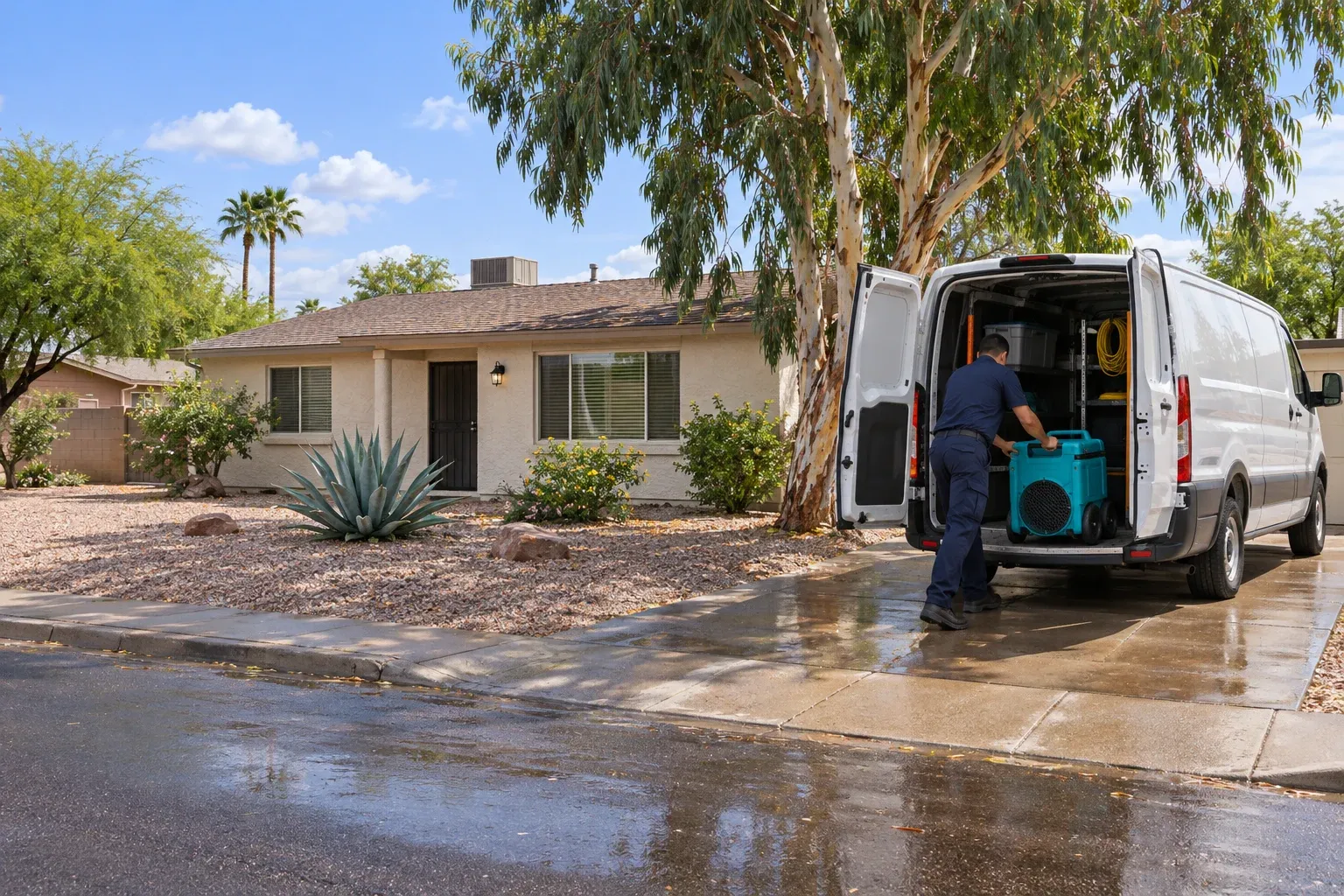
White cargo van with its rear doors open in a driveway, a man in navy work clothes wheeling a teal air machine out in front of a ranch house

Form open 24/7

Get a call back about mold in your home

Send the form. Someone from our team will call you back soon.

Mold in the house?Get a call back

Before you go: want a call back?

Send the request form and someone will call you back about the mold.

Get a call back

Get a call back

Send the form and someone from our team will call you back.