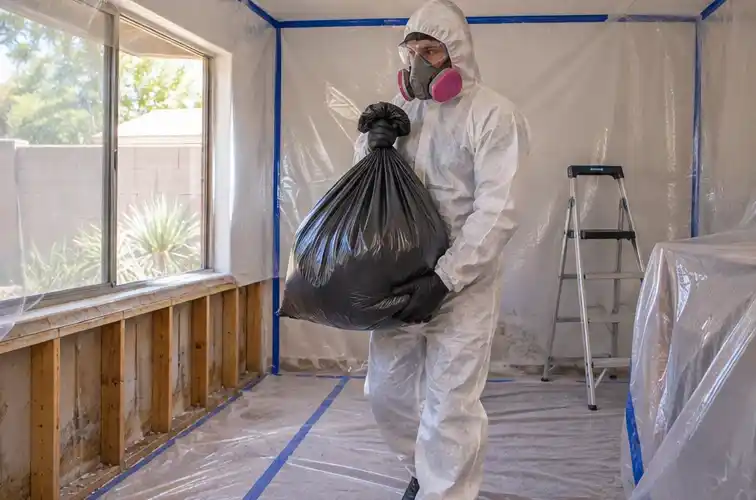
Worker in a white suit and respirator carrying a black debris bag across a plastic-covered floor, an opened lower wall and a stepladder behind

National ranges · named sources

Mold Removal Cost Tempe, AZ

You want a number before you decide. The ranges below are national figures with their sources named. Send the form day or night, and someone from our team will call you back soon.

Mold removal in Tempe costs about $1,500 to $9,000 for a typical remediation, with a national average near $3,500 and small bathroom jobs starting around $500. One national cost guide puts the per-square-foot range at $10 to $30. Inspection and testing are usually separate from remediation: the same guide reports $450 to $800 for an inspection with samples and lab testing, and another national cost guide reports $250 to $500 for testing alone.

Those numbers come from one national cost guide to mold remediation, updated August 29, 2025, with a second national cost guide as a reference. They are national ranges, not quotes for a specific Tempe property. An older rental near ASU and a newer house in Warner Ranch can have the same square footage of growth and very different remediation costs, because access, material and containment are different.

  • 01National rangeSmall bathroom patch$500to$1,500
  • 02National rangeBathroom, easy access$500to$1,000
  • 03National rangeKitchen, cabinet base$1,200to$10,000
  • 04National rangeAttic, sheathing and insulation$1,500to$9,000

01 / Good to know

The quick answer, by job type

JobNational rangeWhat it usually includes
Small bathroom patch$500 to $1,500Surface cleaning, caulk or grout, containment for a small area
Bathroom, easy access$500 to $1,000One national cost guide's range for easily accessed surface mold; another guide's bathroom range runs up to $1,500
Kitchen, cabinet base$1,200 to $10,000Cabinet removal, wall cavity, appliance lines
Attic, sheathing and insulation$1,500 to $9,000Deck cleaning, insulation removal, containment
HVAC and ducts$3,000 to $10,000Air handler, plenum, accessible ducts, coil cleaning
Walls and ceilings$1,000 to $12,000Drywall removal, stud cleaning, drying
Whole home$10,000 to $30,000Multiple rooms, HVAC, full containment

The two headline averages differ. One national cost guide reports a $3,500 national average with a $1,500 to $9,000 range. Another reports a $2,254 average with a $1,125 to $3,439 typical range. Both are national figures, and the ranges on this site follow the first guide, the more recent of the two.

02 / Costs

What drives the price

Eight factors explain most of the gap between a $900 quote and a $9,000 quote.

1. The size of the affected area. Not the size of the house. A 40 square foot bathroom ceiling and a 40 square foot section of attic deck are different jobs because access is different.

2. Access. A vanity cabinet is easy. An air handler platform behind a low roof pitch is not. Access adds labor, containment and sometimes equipment.

3. Material. Porous material that has been colonized comes out: drywall, insulation, cabinet board, carpet, pad. Non-porous material, tile, metal, glass and solid wood can often be cleaned. The mix decides the demolition line.

4. Containment. Negative air machines, plastic, zippers, a decontamination chamber and HEPA filtration are real costs. A quote without containment is a cleaning quote.

5. The moisture source. If the leak is still active, remediation is temporary. Roof, plumbing or HVAC repair comes first, and that work is often a separate trade and a separate invoice.

6. HVAC involvement. Once the air handler, plenum or ducts are affected, the scope grows and the cost moves into the $3,000 to $10,000 range.

7. Verification. Clearance testing or a documented visual verification adds a fee. It is the step that records the result for the owner, landlord or property manager.

8. Occupancy and schedule. After-hours work, a restaurant that cannot close, a tenant who needs access, an elevator or a security escort. Commercial jobs carry line items that a house does not.
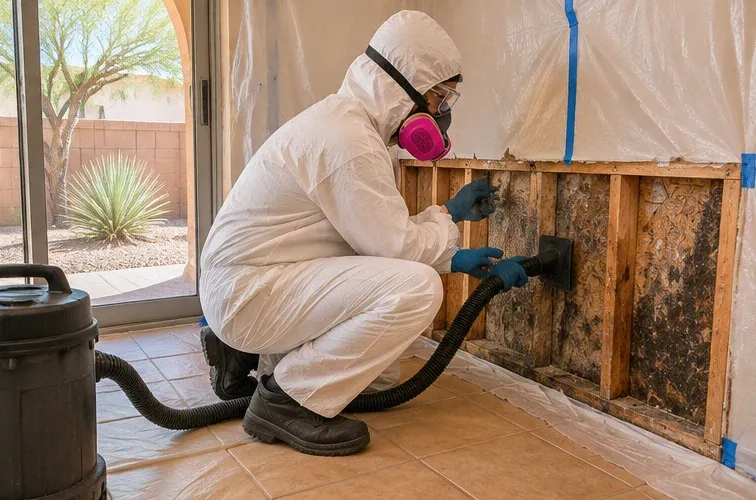
Worker in a white suit and pink respirator vacuuming dark mold from an opened wall cavity beside a sliding glass door, a dark HEPA vacuum at the left

03 / Costs

Cost by area of the home

AreaTypical rangeWhat drives it
Bathroom$500 to $1,500Caulk, grout, vanity base, shower surround, fan
Kitchen$1,200 to $10,000Cabinet base, under-sink wall, dishwasher and ice maker lines
Attic$1,500 to $9,000Roof deck, insulation removal, air handler platform
HVAC and ducts$3,000 to $10,000Duct runs, air handler, coil and plenum access
Walls$1,000 to $12,000Drywall square footage, stud cleaning, texture
Ceilings$1,000 to $9,000Access above, insulation, repaint
Garage$1,500 to $10,000Stored materials, wall area, ventilation
Whole home$10,000 to $30,000Multiple rooms, HVAC, full containment

A note on ceilings: a ceiling stain is often the visible end of a roof or attic problem. The ceiling itself may be a small line item while the attic work is the real scope. The attic above the stain is often part of the scope.

04 / Costs

Cost by square footage

One national cost guide reports a per-square-foot range of $10 to $30 and publishes a size table that applies it. Another reports $10 to $25 for larger jobs. The first guide's table:

Affected areaArithmetic rangeWhat it looks like
50 sq ft$500 to $1,500A small bathroom or closet
100 sq ft$1,000 to $3,000A bathroom ceiling plus one wall
150 sq ft$1,500 to $4,500A small room
200 sq ft$2,000 to $6,000A bedroom or an attic platform
300 sq ft$3,000 to $9,000Several rooms or a full attic
500 sq ft$5,000 to $15,000A large open area with containment
1,000 sq ft$10,000 to $30,000Whole-home scale
1,200 sq ft$12,000 to $36,000Above the typical whole-home range

The arithmetic is simple: affected square footage times $10 for the low end and $30 for the high end. The hard part is deciding what counts as affected area. A company should measure the material that is wet or colonized, not the floor plan of the house.

Three things change the measured area:

  • Both sides of a wall, if both are affected.
  • The ceiling as well as the walls.
  • The cavity behind the drywall, not only the visible surface.

Mold cost checker

sq ft
Where is it

A company should measure the material that is wet or colonized, not the floor plan of the house.

Estimated range

$1,000 to $3,000

Arithmetic on national per-square-foot figures: 100 sq ft × $10 to $30 per sq ft.

Bathroom on the cost page: $500 to $1,500.

EPA line Above about 10 square feet, go straight to a removal scope and use clearance testing after the work. EPA guide (opens in a new tab)

Source: cost page, Cost by square footage ($10 to $30 per square foot, national cost guides) and Cost by area of the home. Inspection and testing are priced separately.

Get a call back

05 / Costs

Inspection and testing costs

Inspection and testing are usually separate from remediation. The ranges:

ServiceNational rangeSource
Inspection, 2,500 sq ft home, two samples with lab testing$450 to $800, average about $500One national cost guide, updated Jan 31, 2025
Inspection, all home sizes$299 to $1,014, average $656Another national cost guide, updated Jun 7, 2024
Mold testing alone$250 to $500 (about $250 to $350 basic, $400 to $500 with lab analysis)Another national cost guide, same page
Low end, 1,000 sq ft, one sampleabout $300One national cost guide
High end, larger home, drywall samplingabout $1,000One national cost guide

The $300 to $1,000 figure used across this site is the rounded national range for an inspection: it matches the low and high examples in one guide and the rounded range in the other. The $450 to $800 and the $299 to $1,014 figures are each guide's own number for a different basis (a 2,500 sq ft home with two samples, and all home sizes), so they are not meant to match. Testing alone is often charged together with the inspection, so the testing figure can overlap with the inspection price rather than add to it.

Clearance testing after remediation is a separate step and often a separate fee. Clearance testing may be included in the remediation quote or billed separately by a third party.

06 / 9 steps

What a quote itemizes

A remediation quote usually has nine parts.

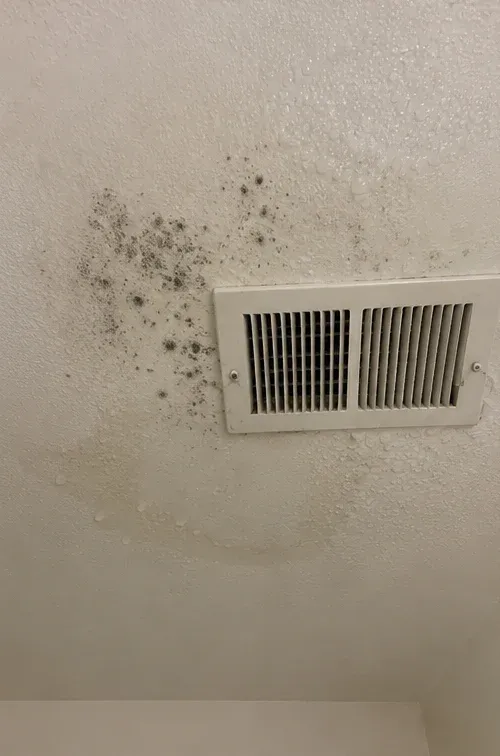
White wall with dark mold spots around a metal floor vent register
  1. Moisture investigation

    What was measured, where, and what the readings were.
  2. Source of the water

    Named, with the repair trade if it is not the remediation company.
  3. Affected area

    Square footage and a room-by-room description.
  4. Containment

    Negative air, plastic, zippers, decontamination chamber.
  5. Removal

    What comes out, and how it is bagged and disposed of.
  6. Cleaning

    HEPA vacuuming, surface cleaning, and the products used.
  7. Drying

    Equipment, number of days, and the daily rate if it is separate.
  8. Verification

    Clearance testing or a documented visual check, and who performs it.
  9. Reconstruction

    Drywall, texture, paint, trim, cabinet or insulation, and whether it is included.

A line that reads "treat mold, $X" is a price without a scope.

07 / 5 steps

Insurance and mold

Mold coverage depends on the cause and the policy. A sudden, accidental discharge from a supply line is treated differently from long-term seepage, a maintenance item, or a roof that has leaked for years. Only the policy and the insurer can say what is covered.

The claim sequence that works:

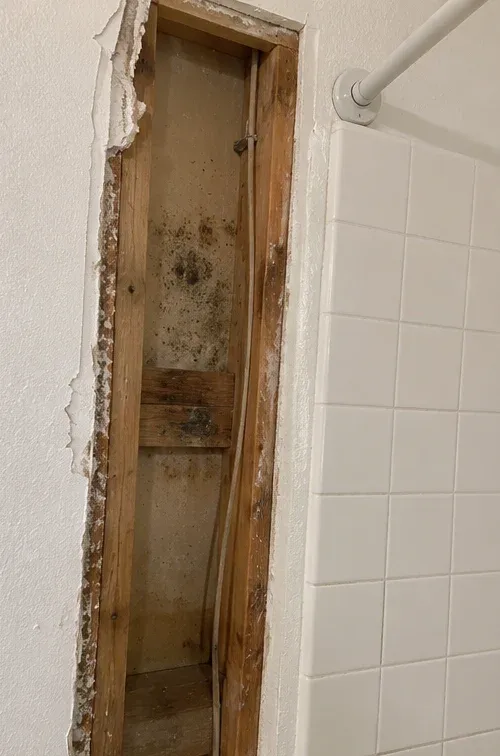
Opened shower wall cavity with wood framing and dark mold above a white tile surround
  1. Stop the water and document the damage before demolition.
  2. Call the insurer and open the claim.
  3. Ask the adjuster what documentation they want

    moisture readings, lab results, photos, scope.
  4. Get the remediation scope in writing, with the moisture source and the clearance step named.
  5. Keep receipts for emergency drying and any temporary repairs.

If the cause is a monsoon roof leak, the conversation often turns on maintenance. If the cause is a failed supply line, it often turns on sudden and accidental damage. Either way, the paperwork starts with the water.

Timing matters as much as coverage. Many carriers want notice before permanent repairs, and a claim opened after the drywall is back up is harder to support. Keep the damaged material until the adjuster has seen it or has said it can go. Photograph the moisture readings and the removal, not only the visible stain. If a denial arrives, read the specific policy language before assuming the answer is final, and ask the adjuster which exclusion applies.

08 / Good to know

Permits, licenses and Arizona rules

Arizona contractor licensing generally applies when labor and materials exceed $1,000, or when the work requires a permit. Remediation that involves drywall, insulation or cabinet removal, plus rebuilding, can cross that line. The Arizona contractor license page explains how licensing works.

Permits are a separate question and are set by the city. Whether a scope needs one depends on the work, for example structural, electrical, plumbing or gas work.

09 / Costs

Payment and financing

Payment schedules vary. A common structure is a deposit, a progress payment when the work starts, and the balance after verification.

Financing is available through some remediation companies and through home improvement lenders. Financing terms list a total cost and a monthly payment. For a rental property, the owner and the property manager should agree in writing on who pays which invoice before the work starts.

10 / Good to know

What a change order looks like

A change order is a written addition to the scope and the price. It is normal on mold work because the damage behind the drywall is not visible until the drywall comes off. A change order records how the change is priced and that it was agreed in advance.

The common changes:

  • A wet cavity that was not in the original scope. The contractor opens a wall and finds the stud bay wet two feet beyond the visible growth.
  • A failed clearance test. The lab finds elevated spores after the work, and the contractor has to clean again.
  • HVAC work that was excluded. The air handler or the duct run is colonized and the original quote only covered the room.
  • Reconstruction. New drywall, texture and paint were excluded and now have to be added.
  • A second source. The roof leak was fixed, but the condensate line was also overflowing.

A lump-sum quote carries an exclusion list. A time-and-materials quote lists its rates and estimated hours.

A change order usually follows three conventions:

  1. Work is approved in writing, including by email.
  2. The change states what is added, the price and the new schedule.
  3. A contingency can be agreed in advance on a job where the cavity is unknown.
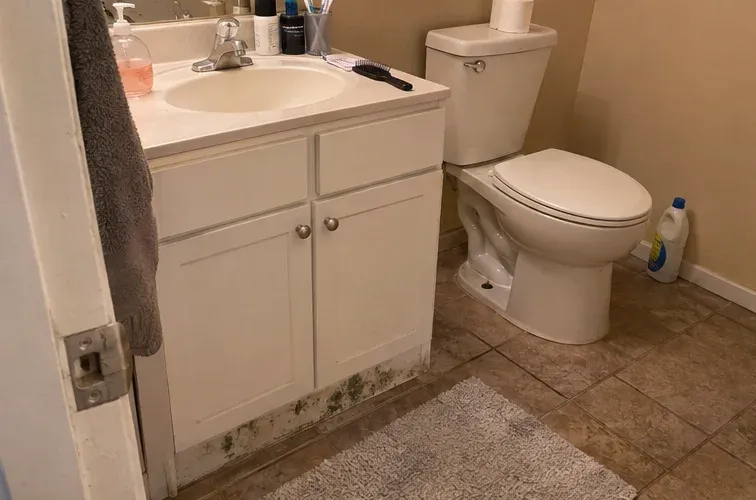
Bathroom with a white vanity, dark mold staining along the vanity base and the wall beside it, a toilet and a gray towel at the left

11 / 11 questions

Frequently asked questions

Still have a question?

Send the form. Someone from our team will call you back soon.

Get a call back

Q.01

How much does mold removal cost in Tempe?

National ranges run about $1,500 to $9,000, with a typical job near $3,500 and small bathroom work starting around $500. Per-square-foot pricing is $10 to $30. Tempe quotes depend on access, material, containment and whether the moisture source is fixed.

Q.02

Is mold removal covered by homeowners insurance?

Sometimes. Coverage depends on the cause and the policy. A sudden supply line failure is treated differently from long-term seepage or a maintenance item. Document the source and call the insurer before demolition.

Q.03

How much does a mold inspection cost?

One national cost guide reports $450 to $800, with a national average near $500 for a 2,500 square foot home and two samples with lab testing. Another reports $299 to $1,014 across home sizes, with an average of $656. The rounded national range is about $300 to $1,000.

Q.04

How much does mold testing cost?

One national cost guide reports $250 to $500 for testing alone: about $250 to $350 for basic testing and about $400 to $500 with lab analysis. Inspection and testing are often charged together, so the two can overlap.

Q.05

Do I have to move out during remediation?

For a contained bathroom, closet or single room, usually not. For a whole-home job with extensive demolition or HVAC work, the answer may be different. The scope usually states the occupancy plan.

Q.06

How long does mold remediation take?

How long it takes depends on the size of the area, the material that comes out and the drying time. Small jobs can be short, and attic and HVAC jobs usually take longer.

Q.07

Can I negotiate the price?

A smaller scope, a staged schedule and a separate price for reconstruction are the usual ways a price moves. Containment, drying and clearance are the parts that make the job work, so they stay in any scope.

Q.08

Why is one quote so much cheaper?

Usually because it covers less: containment, removal, drying, verification, the moisture repair or the reconstruction. The nine itemized parts above show where the difference usually sits.

Q.09

Does insurance cover mold in a rental property?

It depends on the policy and the cause. A landlord policy may cover a sudden water event and may exclude long-term seepage. The tenant's renters policy may cover personal property. Ask each insurer.

Q.10

Are payment plans available?

Some remediation companies and home improvement lenders offer financing. The terms list the total cost and the monthly payment.

Q.11

What if I cannot afford remediation right now?

Fix the water source first. That is the step that stops the damage from getting worse. Then ask for a staged scope: containment and removal now, reconstruction later. Do not cover the growth with paint or new drywall.

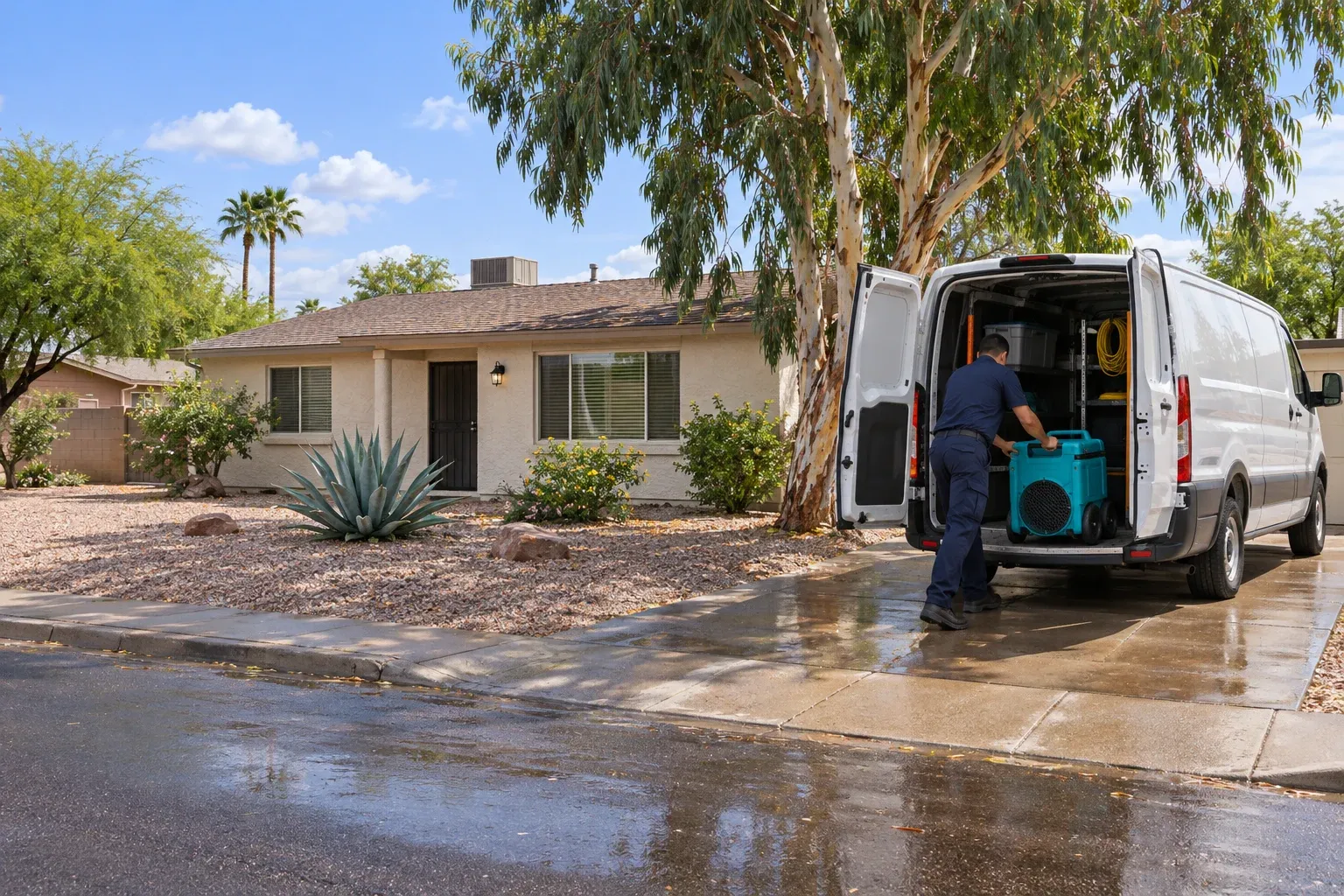
White cargo van with its rear doors open in a driveway, a man in navy work clothes wheeling a teal air machine out in front of a ranch house

Form open 24/7

Get a call back about mold in your home

Send the form. Someone from our team will call you back soon.

Mold in the house?Get a call back

Before you go: want a call back?

Send the request form and someone will call you back about the mold.

Get a call back

Get a call back

Send the form and someone from our team will call you back.