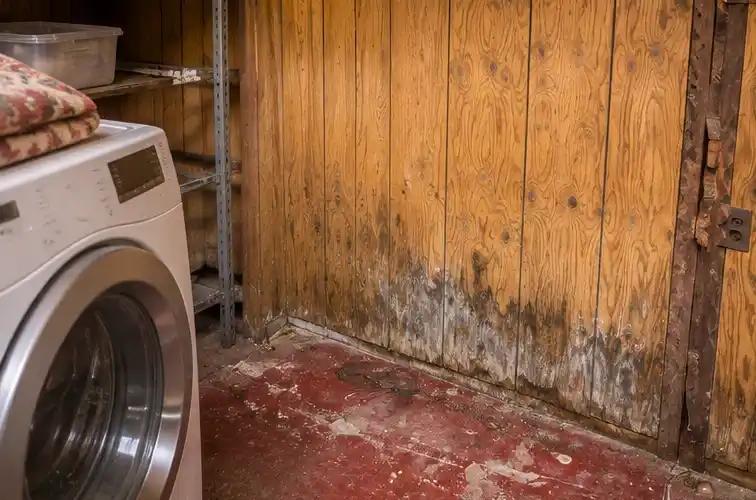
Water-stained wooden plank wall with dark mold marks beside a front-loading washer, red concrete floor at the bottom

Tempe guide · 6 min read

Mold From Neighbor's Apartment

Water crosses shared walls and floors without asking permission.

Tracing it back to the unit that owns the leak is the whole job, and the paper trail starts with you.

Mold from a neighbor unit in Tempe starts with water that crossed a shared assembly: a floor, a wall, a pipe chase or a common roof. The growth appears in the unit that did not cause it, which is why the first move is to trace the water back rather than to clean the visible surface. The second move is to put the whole chain in writing, because the fix usually needs access to a unit someone else controls.

Shared buildings are a large part of the local housing stock. ACS 2024 5-year data puts 41.8 percent of Tempe homes in buildings with 5 or more units and 57.7 percent of occupied homes in the rental market. In a building of that type, a leak on an upper floor can surface in a lower unit days later, and the unit that shows the growth may never be the unit with the failed fitting.
01 / Good to know

Water does not stop at a property line

A shared building has more paths for water than a house. The common ones:

  • Through the floor assembly. A supply line, a tub overflow or a water heater pan in the unit above drains into the ceiling below.
  • Through a shared wall. A shower valve, a washing machine box or a hose bib on the other side of the wall wets the cavity between units.
  • Along a pipe chase. Condensate, drain water and roof water follow pipes and conduit through several floors.
  • Under a common roof. A roof leak or a blocked scupper wets the top unit and then the ones below.
  • Across a balcony or walkway. Water pools at a door threshold and wicks into the wall and the carpet.

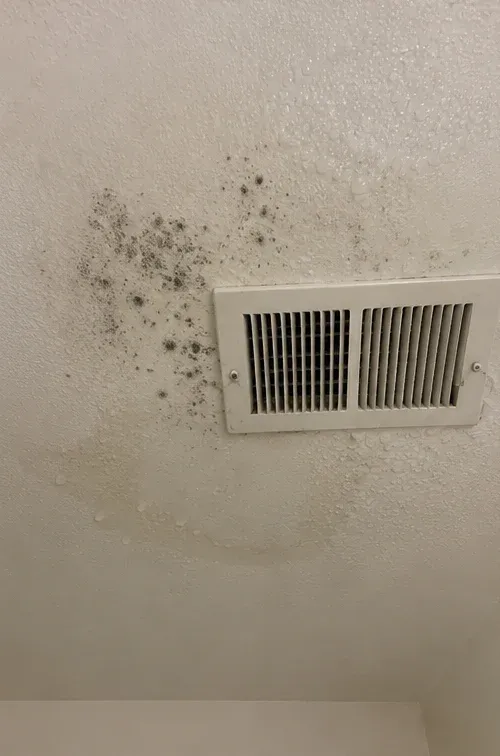
Each path leaves a pattern. A ceiling stain with a sharp edge points at a single event from above. A stain that creeps along a baseboard points at a wall cavity or a slab. A musty closet with no visible growth often points at a chase.

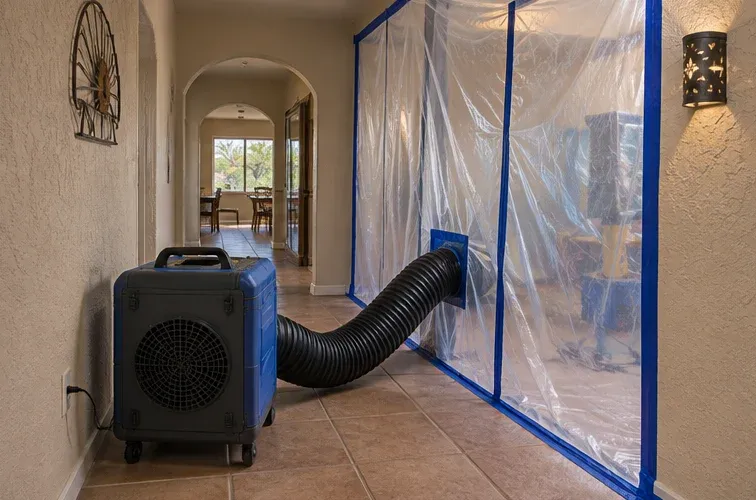
Dark air scrubber with a black duct hose running into plastic sheeting taped in a hallway of a tile-floored house

02 / Good to know

Read the direction of the evidence

Before anyone cuts drywall, the pattern tells you where to look.

What you seeLikely directionFirst check
Ring on the ceiling, directly below a bathroomFrom the unit aboveSupply line, tub overflow, toilet seal
Growth along the base of a shared wallFrom the unit beside, or from belowWall cavity, slab, exterior grade
Musty closet with pipes in itChase running through the buildingCondensate line, drain line, roof penetration
Stain at the top of a wall under a balconyBuilding envelopeDoor threshold, flashing, stucco crack

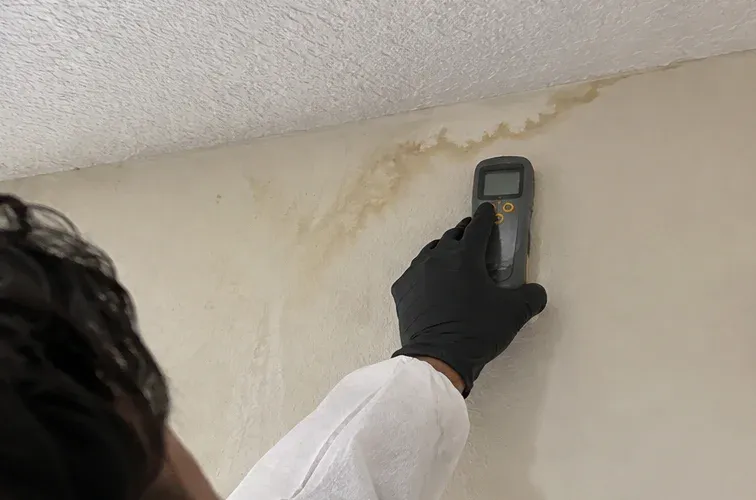
A moisture meter confirms the direction. Readings that are high on the ceiling and drop down the wall point up. Readings that are high at the baseboard and dry at the ceiling point down or sideways.

03 / 5 steps

The trace, step by step

White wall with dark mold spots around a metal floor vent register
  1. Stop what you can

    If water is running into the unit, shut off the fixture you control or call the manager. Do not open a wall in someone else's unit.
  2. Photograph the pattern

    Wide shot, close shot, and a moisture reading at each spot. Include the date.
  3. Write to the manager or board

    Name the rooms, the pattern, the date the water was first seen, and ask for an inspection of the unit above or beside.
  4. Ask for the source report

    The inspection should name the failed component, not just the room. "Supply line to the hall bath" is a source. "Water damage" is not.
  5. Get the scope before the repair

    The scope should say which unit gets opened, who repairs the source, and who closes and paints.

The mold testing page explains what an inspection report usually contains and when sampling adds anything. In most visible-growth cases it does not, because EPA says sampling is unnecessary when growth is visible and no federal limits have been set.

04 / Good to know

The access problem

The hard part of a neighbor case is access. A tenant cannot enter another unit. An owner cannot force entry. A manager can enter for repairs under the lease, and a board can act under the governing documents, but each of those steps needs a written request and some time.

What moves the process:

  • A written request to the manager or board that names the suspected unit and the reason for entry.
  • A photo set that shows the pattern and the readings, attached to the request.
  • A request for the inspection date in writing, so a delay is visible.

The HOA guide covers the documents and the board process.

05 / Costs

Who pays, in general terms

Responsibility usually follows the source and the governing documents, not the location of the growth. The table is a starting point.

SourceUsual starting point
Failed supply line inside another owner's unitThat owner or that owner's insurance
Common pipe or roof owned by the associationThe association, under the declaration
Tenant-caused overflow in a rented unitThe tenant, the owner and the lease decide
Construction defect in a shared assemblyThe association and its counsel decide
Repeated condensate overflow from an AC unitThe owner of that unit in most cases

Insurance follows the same logic but with its own rules. A renter policy may cover personal property and loss of use. An owner policy may cover the building portions the owner insures. The association policy may cover common elements. Ask each carrier what it needs, and keep the same photo set for all of them.

06 / Insurance

Document like the claim is already open

A neighbor case can involve three parties, two insurers and a manager, so the file needs to be boring and complete.

  • Date and time of first observation, and the weather that week.
  • Photos of every affected surface, with scale, plus a video walk.
  • Moisture readings in a simple table, by room and date.
  • Every written notice, and every reply, in one folder.
  • The source report and the repair scope.
  • Receipts for anything you bought or paid for, such as a fan, a hotel night or a cleaning.

Do not throw away the early photos after a repair. If the growth returns in the same place, the first set is what proves the source was never fixed.

Gloved hand holding a moisture meter against a wall with brown water stains below a textured ceiling

07 / Sources

When the source unit is empty

A vacant unit is a common reason a neighbor leak runs for weeks. The water has no one to notice it, and the unit below takes the damage.

If the unit above is empty, ask the manager or board, in writing, for a welfare and leak check. Name the suspected fixture if the pattern points at one. In a condo, the board may have a key or a maintenance contact. In an apartment, the manager does.

If the building is in a rental pool, the owner may be out of state. That is a reason for a manager to act, not a reason to wait. For the aftermath inside a rented unit, the rental mold guide covers notice and the deposit question.

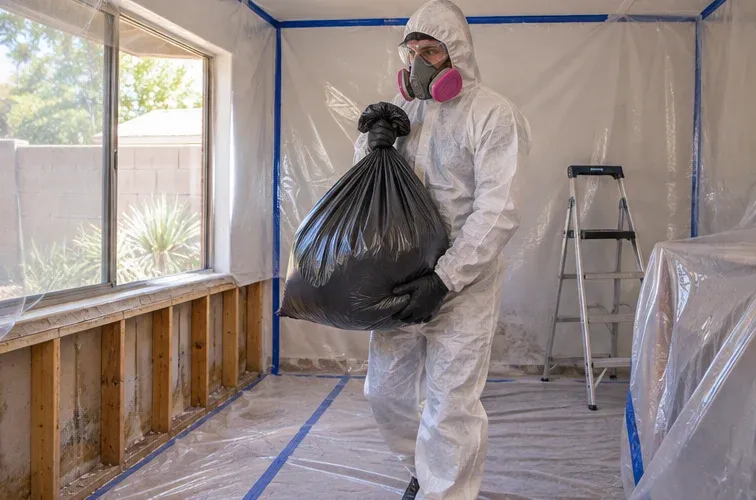
Worker in a white suit and respirator carrying a black debris bag across a plastic-covered floor, an opened lower wall and a stepladder behind

09 / 6 questions

Frequently asked questions

Still have a question?

Send the form. Someone from our team will call you back soon.

Get a call back

Q.01

Can mold come through a shared wall from the next unit?

Yes. Water moves through the wall cavity, the floor assembly and the pipe chases, and the growth can appear on the dry side. The pattern of the stain usually points at the direction the water traveled.

Q.02

Who pays when the leak is in the neighbor's unit?

Usually the owner of the unit where the source sits, or that owner's insurance. A common pipe or the roof may belong to the association. The declaration and the policies decide.

Q.03

What if the neighbor will not let anyone in?

Ask the manager or the board in writing to arrange access, and keep the request. A tenant cannot enter another unit, but a manager can arrange a repair entry under the lease, and a board can act under the governing documents.

Q.04

Should the mold be cleaned before the source is fixed?

Cleaning before the source stops means the growth returns. Photograph it, report it, and wait for the source repair and the drying step before the final cleaning and rebuild.

Q.05

How long does a neighbor case take?

It depends on access and on how many parties are involved. A simple case with a cooperative owner can move in days. A case that needs a board decision or an insurance adjuster can take weeks. The written request date is what keeps it moving.

Q.06

Is sampling needed to prove the source?

Usually not. Visible growth plus moisture readings plus a plumbing or roof finding is the usual evidence. Sampling is more useful when the growth is hidden or the parties dispute whether it is mold at all.

White cargo van with its rear doors open in a driveway, a man in navy work clothes wheeling a teal air machine out in front of a ranch house

Form open 24/7

Get a call back about mold in your home

Send the form. Someone from our team will call you back soon.

Mold in the house?Get a call back

Before you go: want a call back?

Send the request form and someone will call you back about the mold.

Get a call back

Get a call back

Send the form and someone from our team will call you back.