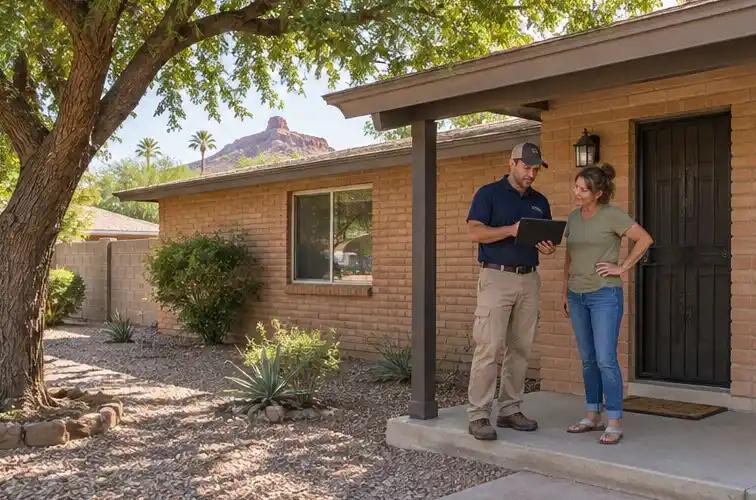
Man in a navy shirt holding a tablet talks with a woman on the walkway of a brick ranch house with a shade tree and a gravel yard

Tempe guide · 6 min read

HOA Mold Responsibility

An HOA does not own every wall and does not ignore every leak.

The declaration decides which parts the association maintains, and the board acts on what it owns.

Two documents decide almost every HOA mold question: the declaration and the maintenance matrix. They say which parts of the building the association repairs and which parts belong to the owner. In a Tempe condo, HOA mold responsibility follows that division, not the location of the stain. The board's job is to act on what it owns, on a schedule, with a record. The owner's job is to report the water in writing and keep the evidence.

That division matters because so much of Tempe is attached housing. ACS 2024 5-year data puts 41.8 percent of homes in buildings with 5 or more units, and 57.7 percent of occupied homes are rented. In a building where one roof covers many units, a single failed flashing can produce growth in several of them, and each owner will ask the board the same question.

01 / Questions

The two questions that decide most cases

Almost every HOA mold conversation reduces to two questions.

What is the association responsible for maintaining? The declaration, the plats and the maintenance matrix answer this. Roofs, common plumbing risers, exterior walls, walkways and shared mechanical equipment are often association items. Interior finishes, fixtures and anything installed by the owner are often owner items. Declarations differ from building to building.

What caused the water? A failed common roof is a different case from a shower pan that was never sealed. A clogged condensate line on an owner's air handler is different from a broken riser. The cause, not the location of the stain, usually decides who pays.

Neither question has a general answer. A board or owner with a specific dispute should read the declaration and talk to the association's attorney.

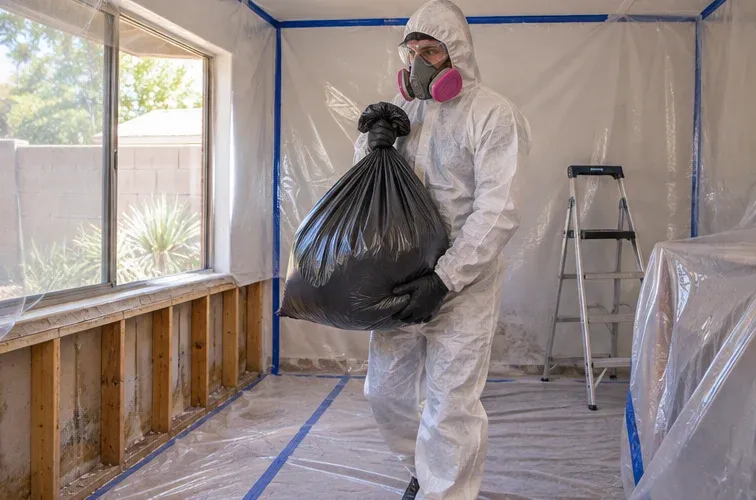
Worker in a white suit and respirator carrying a black debris bag across a plastic-covered floor, an opened lower wall and a stepladder behind

02 / Good to know

Common element or owner unit

Building partUsual treatmentWhat the board needs
Roof and roof flashingAssociationRoof report, scope, schedule
Exterior stucco and window framesAssociationVendor inspection and a repair date
Common plumbing riserAssociationPlumber report and access plan
Water heater and its panUsually the ownerOwner repair, with the board notified
AC air handler and condensate lineUsually the ownerOwner repair, with the board notified
Interior drywall and paintUsually the ownerOwner scope, and a copy to the board
Shared wall cavity between unitsDepends on the declarationA written determination before work

The last row is the one that causes the most argument. When the cavity between two units is wet, the declaration, the plats and sometimes a structural engineer decide which side owns the repair. A board that guesses can end up paying twice.

03 / Good to know

What the board should keep on file

A board that can answer a records request quickly tends to have fewer disputes. The useful file includes:

  • the declaration, bylaws and any recorded amendments
  • the maintenance matrix or responsibility chart, if the association has one
  • the current insurance policies and the agent contact
  • a roof and envelope inspection report with a date
  • a list of the vendors used for roofing, plumbing and remediation
  • a log of water intrusion reports by unit and date
  • the minutes where each repair was approved

A log is the item most associations lack. Without it, the board cannot see that the same stack of units has reported a leak three times in two years, which is the pattern that points at a building defect rather than a single fixture.

04 / 7 steps

How a board should handle a report

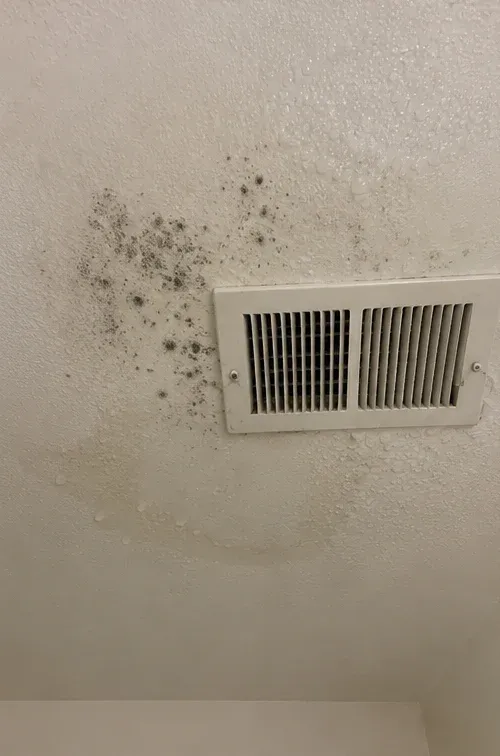
White wall with dark mold spots around a metal floor vent register
  1. Log the report

    Unit, date, room, who reported it, and what they saw.
  2. Inspect the association portion

    Roof, attic, exterior wall, common pipe. Do this even when the growth is inside a unit, because the source may be on the association side.
  3. Get a written finding

    The finding names the failed component and the extent of the moisture.
  4. Decide ownership in writing

    Reference the declaration section. If the answer is unclear, get counsel before authorizing work.
  5. Authorize the scope

    Containment, removal, drying, verification and rebuild, with a start date.
  6. Notify the affected owners

    In writing, with the schedule and any access needs.
  7. Close the file with photos and a verification note

The board does not need to supervise the work. It needs to be able to show that it acted on the information it had, on a date.

05 / Good to know

The owner's paper trail

An owner in a condo or townhome should keep a file that mirrors the board's:

  • photos of the growth and the moisture source, with dates
  • the written report to the board or manager
  • the board's reply, or a note that no reply came
  • the vendor's finding and scope
  • receipts for any emergency mitigation, such as a fan or a wet vacuum rental
  • the insurance claim number, if there is one

Send reports to the board and the manager, not just the manager. A management company can change, and a board that never saw the report cannot be expected to act on it.

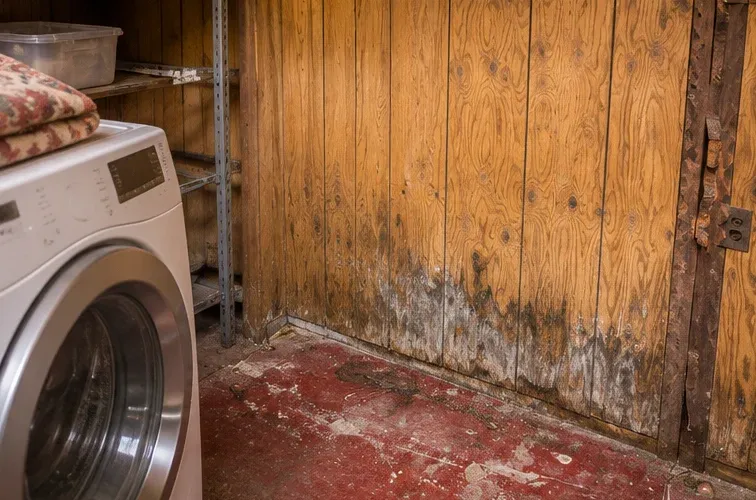
Water-stained wooden plank wall with dark mold marks beside a front-loading washer, red concrete floor at the bottom

06 / Paperwork

What a repair scope lists

A written scope for a common element repair lists the square footage, the containment plan, the drying plan and a verification step. The license page covers when Arizona requires a contractor license.

08 / 1 questions

Assessments, insurance and the money question

Still have a question?

Send the form. Someone from our team will call you back soon.

Get a call back

A common element repair is usually funded from the operating budget, the reserve fund or a special assessment. Which one applies is a board decision governed by the bylaws and the budget. An owner who wants to know should ask for the agenda item and the minutes, not a verbal answer in the hallway.

Insurance is a separate track. The association policy may cover common elements. An owner policy may cover unit improvements and personal property. A renter policy may cover the tenant's belongings. Each carrier will ask for the same things: the cause, the date, the photos and the scope.

Neither the board nor the owner should assume that one policy covers the whole loss. Ask each carrier what it covers before the work starts, and put the answer in the file.

Q.01

When the source is another unit

Water that starts in a neighboring unit is a common HOA case, and it is one where boards can hesitate. The association may own the pipe, the owner may own the fixture, and the tenant may have caused the overflow. Three parties, three positions.

The neighbor unit guide walks through the source trace and the access request. The short version: report in writing, ask for an inspection of the suspected unit, get the finding, then decide ownership.
09 / 6 questions

Frequently asked questions

Still have a question?

Send the form. Someone from our team will call you back soon.

Get a call back

Q.01

Is the HOA responsible for mold in a Tempe condo?

It depends on what the declaration says the association maintains and what caused the water. The association is usually responsible for common elements such as the roof and shared pipes, while the owner usually handles the interior.

Q.02

Does the board have to fix mold inside a unit?

Usually no, unless the declaration makes the assembly a common element or the association caused the condition. The board may still need to fix the source if it sits on the common side.

Q.03

Can an owner refuse access for a common repair?

The declaration and the bylaws usually include an access right for association repairs, with notice. An owner who refuses can delay the fix for every unit in the stack. Ask the manager for the notice requirement in writing.

Q.04

Who pays for the remediation?

The party that owns the failed component, under the declaration, and that party's insurance. A special assessment may fund a common repair. A specific dispute needs counsel.

Q.05

Should the board get a mold inspection?

Get a moisture inspection and a written finding first. Sampling adds little when growth is visible, and EPA says no federal limits have been set for mold or mold spores. A full mold inspection makes sense when the extent is unclear or the cause is disputed.

Q.06

How should a board document the decision?

Put the finding, the declaration section, the scope, the cost and the vote in the minutes. Attach the photos. A decision that is not in the minutes is hard to defend a year later.

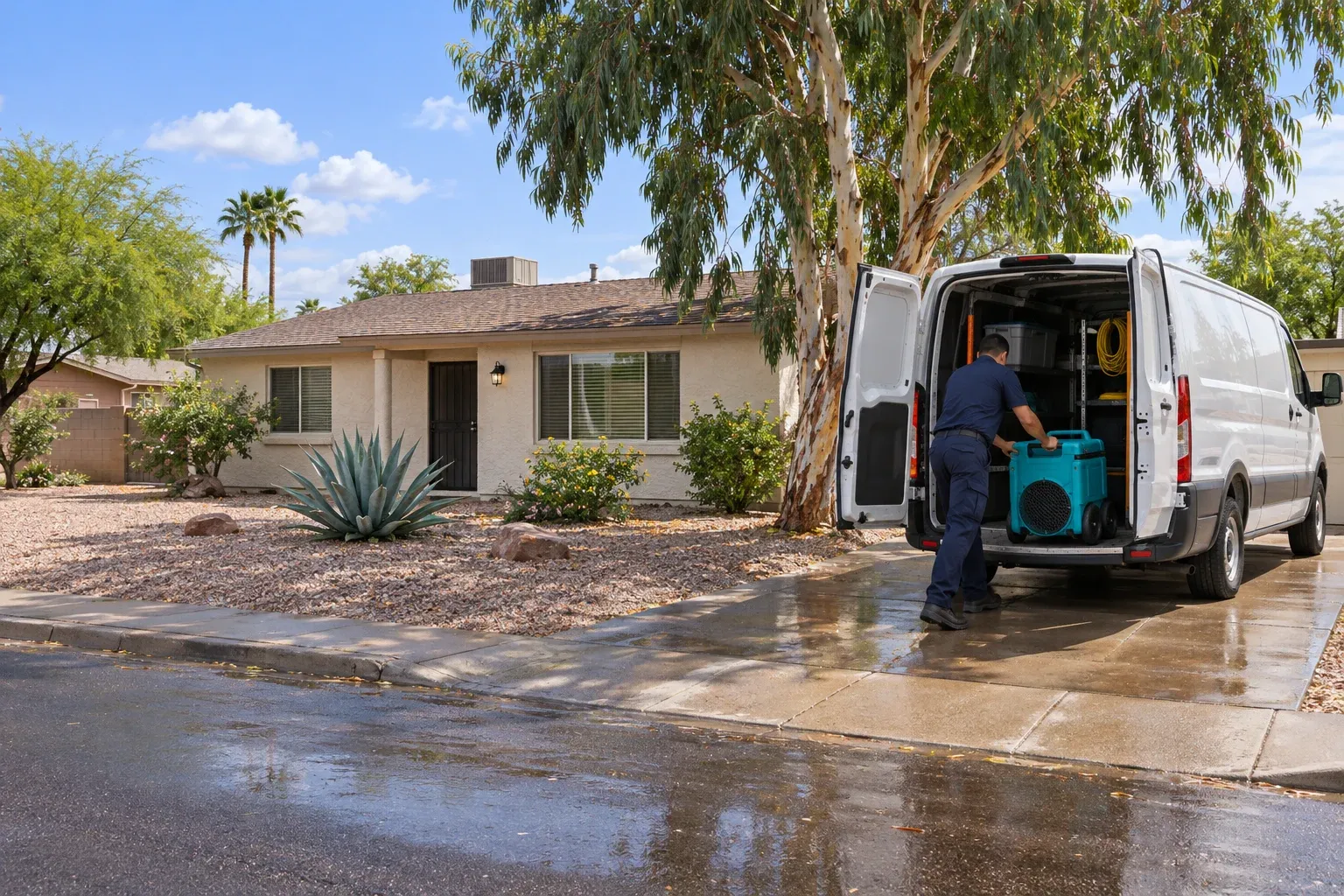
White cargo van with its rear doors open in a driveway, a man in navy work clothes wheeling a teal air machine out in front of a ranch house

Form open 24/7

Get a call back about mold in your home

Send the form. Someone from our team will call you back soon.

Mold in the house?Get a call back

Before you go: want a call back?

Send the request form and someone will call you back about the mold.

Get a call back

Get a call back

Send the form and someone from our team will call you back.