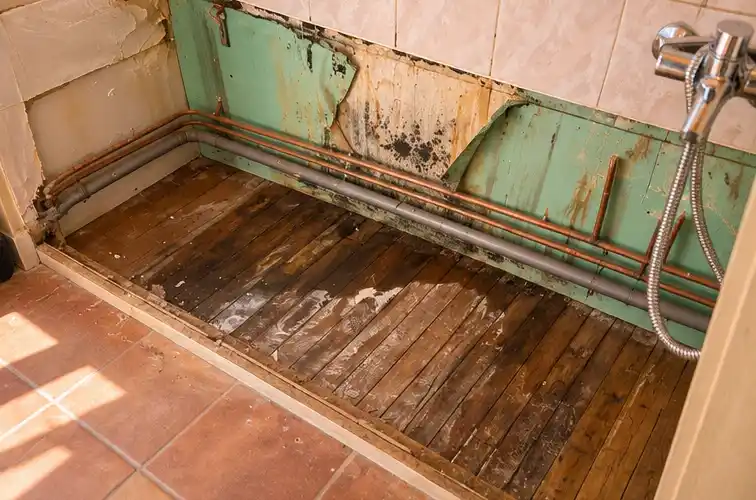
Opened shower wall showing dark mold and rust stains on the wood backing, a green wall panel and shower arm at the right, tile floor below

Tempe guide · 6 min read

What Not to Put on Mold

Bleach, paint, caulk and ozone all get used on mold, and each one fails on porous material.

Most products sold for mold treat the surface. On drywall, wood and carpet the growth is inside the material, and a surface product mostly adds moisture.

The things not to put on mold are mostly things that add water, seal water in, or move spores around. In Tempe, where a bathroom ceiling or a windowsill can stay damp for weeks, the wrong product turns a small patch into a bigger removal. Bleach on drywall, paint over a stain, caulk around a soft baseboard and a box fan aimed at the wall all share the same flaw: they treat what you can see and leave the moisture that produced it.

The first question is not which product to buy. It is whether the material is porous. Drywall, ceiling tile, wood trim, carpet, insulation and cabinet board all absorb water and growth. Once growth is inside those materials, cleaning the face does not clean the material.
Do and do not

What not to put on mold, and what to do instead

Do not

Products that add water or trap it

  • 01

    Bleach on drywall, wood or fabric

    Bleach is a surface disinfectant. It does not penetrate paper, gypsum or wood fibers, and applying it wets the material again. The patch looks lighter for a while, the damp stays, and growth comes back. On glazed tile or grout, the EPA describes detergent and water as the routine method and does not recommend bleach as a routine practice. On a wall, it is the wrong tool.

  • 02

    Paint and primer

    Paint can act as a vapor barrier in a thin coat. Over a damp patch it traps moisture in the substrate, and the growth continues behind the film. The paint eventually blisters or peels, and by then the drywall underneath is softer than it was. Stain-blocking primer has the same problem: it hides the evidence, not the water.

  • 03

    Caulk and sealant

    Running a bead of caulk along a baseboard or around a window frame hides the gap and keeps the cavity from drying. Water that was slowly evaporating now stays in the wall. Caulk belongs on a dry, sound joint after the leak is fixed, not over a wet one.

  • 04

    Carpet shampoo and household cleaners

    Shampooing a carpet adds water to the pad and the tack strip, which are the parts that stay wet longest. A carpet that has supported growth in the pad usually needs the pad and carpet removed, not cleaned harder.

  • 05

    Encapsulant over a wet assembly

    A coating that seals growth in place can be appropriate on a dry, cleaned surface as part of a defined scope. Over a wet assembly it traps moisture and makes the eventual removal larger. The coating also hides the material from the next inspector.

Products that treat air and not material

  • 06

    Ozone generators

    An ozone device changes the air in a room. It does not clean growth out of a wall cavity, a duct or a carpet pad, and the effect ends when the machine does. The material is exactly where it was.

  • 07

    UV lamps and air purifiers

    UV light affects what it shines on. Inside a wall, behind a baseboard or under a cabinet, the light does not reach. An air purifier can reduce what is floating in a room, which is a different question from what is growing on the framing.

  • 08

    Essential oil sprays and vinegar as a treatment

    Both can affect growth on a hard surface and both leave the water source untouched. They also mask the musty smell that helps locate the problem. A room that smells like tea tree oil and still has a damp wall is a room with a hidden leak.

Actions that spread it

  • 09

    A fan pointed at the wall, and a vacuum without a HEPA filter

    Air movement is useful for drying a wet room. Aimed at a moldy surface, it lifts spores into the air and distributes them through the house. A shop vacuum without a HEPA filter does the same thing with more force. Bag the material and remove it, rather than blowing it around.

Do this instead

What to do instead

The order matters more than the product.

  1. Stop the water

    Fix the leak, the fan termination, the condensate line or the grade. If the water is still arriving, nothing else works.
  2. Decide whether the material is porous

    Hard surfaces can be cleaned. Porous ones usually come out.
  3. Remove what is penetrated

    Cut drywall back past the visible growth, bag it, and take it out of the house. The same goes for insulation, ceiling tile and carpet pad.
  4. Clean the framing

    HEPA vacuum, then damp wipe with detergent and water, which is the method the EPA describes for hard surfaces.
  5. Dry the cavity

    Air movement and a dehumidifier, with a meter reading to confirm the framing is dry before it is closed.
  6. Keep the room in range

    Indoor humidity below 60 percent, ideally 30 to 50 percent. In Tempe, that is mostly the AC and the exhaust fan doing their jobs.

The EPA's guidance is consistent on this: mold needs moisture, so the moisture is the thing to manage. A product that does not change the moisture has not changed the problem.

02 / Local risk

Why this matters more in Tempe

The city's housing stock gives moisture more places to hide. Tempe has a lot of pre-1980 housing: 41.2 percent of occupied units predate 1980, and 41.8 percent sit in buildings of five or more units. That means attic fan terminations in houses and shared chases in apartments, both of which move moisture out of sight.

Monsoon season, June 15 to September 30, adds wind-driven rain at roof details and window flashing. A windowsill that gets caulked in July without fixing the flashing can be wet again in August, and the caulk can hide it until the trim softens.

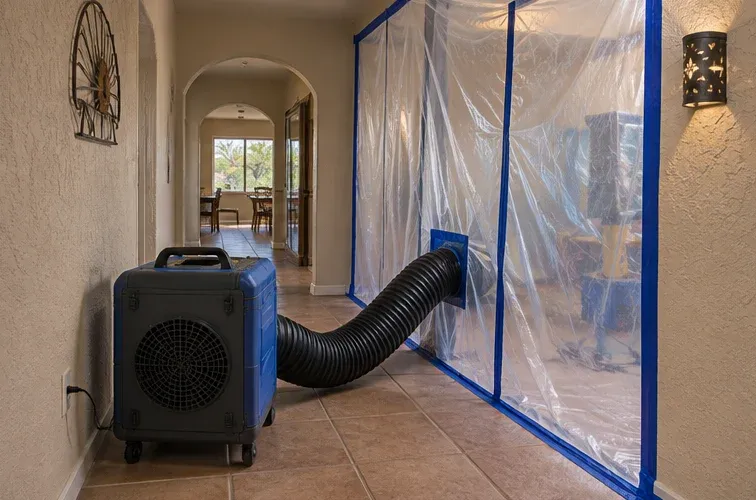
Dark air scrubber with a black duct hose running into plastic sheeting taped in a hallway of a tile-floored house

03 / Good to know

A small patch you can handle

Under about 10 square feet, the EPA's rough line puts the job within reach of a homeowner, provided the water is already fixed. For a bathroom ceiling patch:

  • Cover the floor with plastic.
  • Cut out the affected drywall with a margin.
  • Bag the pieces and carry them out.
  • HEPA vacuum and damp wipe the joists.
  • Let the cavity dry, then check it with a meter.
  • Patch only when the reading is dry.

If the patch keeps coming back after that sequence, the water is still there. At that point the question is not which cleaner to try next. It is where the water is coming from, and the mold testing page covers how to find it.

04 / Paperwork

When to stop and call for a scope

Call for a removal scope when the area is larger than about 10 square feet, when the growth is inside a cavity or duct, when the material has been wet for days, or when the smell persists after cleaning. Black mold removal covers the containment and removal sequence, and what kills mold permanently explains why no spray finishes the job on its own.

05 / 5 questions

Frequently asked questions

Still have a question?

Send the form. Someone from our team will call you back soon.

Get a call back

Q.01

Can I use bleach on mold?

On glazed tile or grout, the EPA describes detergent and water as the routine method rather than bleach. On drywall, wood, fabric or carpet, bleach does not penetrate the material and adds water to it. The growth usually returns.

Q.02

Does painting over mold work?

No. Paint seals moisture into the substrate and hides the evidence. The growth continues behind the film, and the drywall or wood keeps degrading until the material is removed.

Q.03

Is vinegar better than bleach for mold?

Vinegar is gentler on some surfaces and leaves no residue, but it has the same limit. It treats the surface and does not reach growth inside a porous material or fix the water source.

Q.04

Can I just caulk around the baseboard?

Not while the wall is wet. Caulk traps moisture in the cavity and slows drying. Fix the leak, dry the assembly, and caulk the joint afterward if it still needs sealing.

Q.05

What should I put on mold right now?

Stop the water, then remove the porous material or clean the hard surface with detergent and water and dry it. If the area is larger than about 10 square feet, or you cannot find the water, get a scope instead of another product.

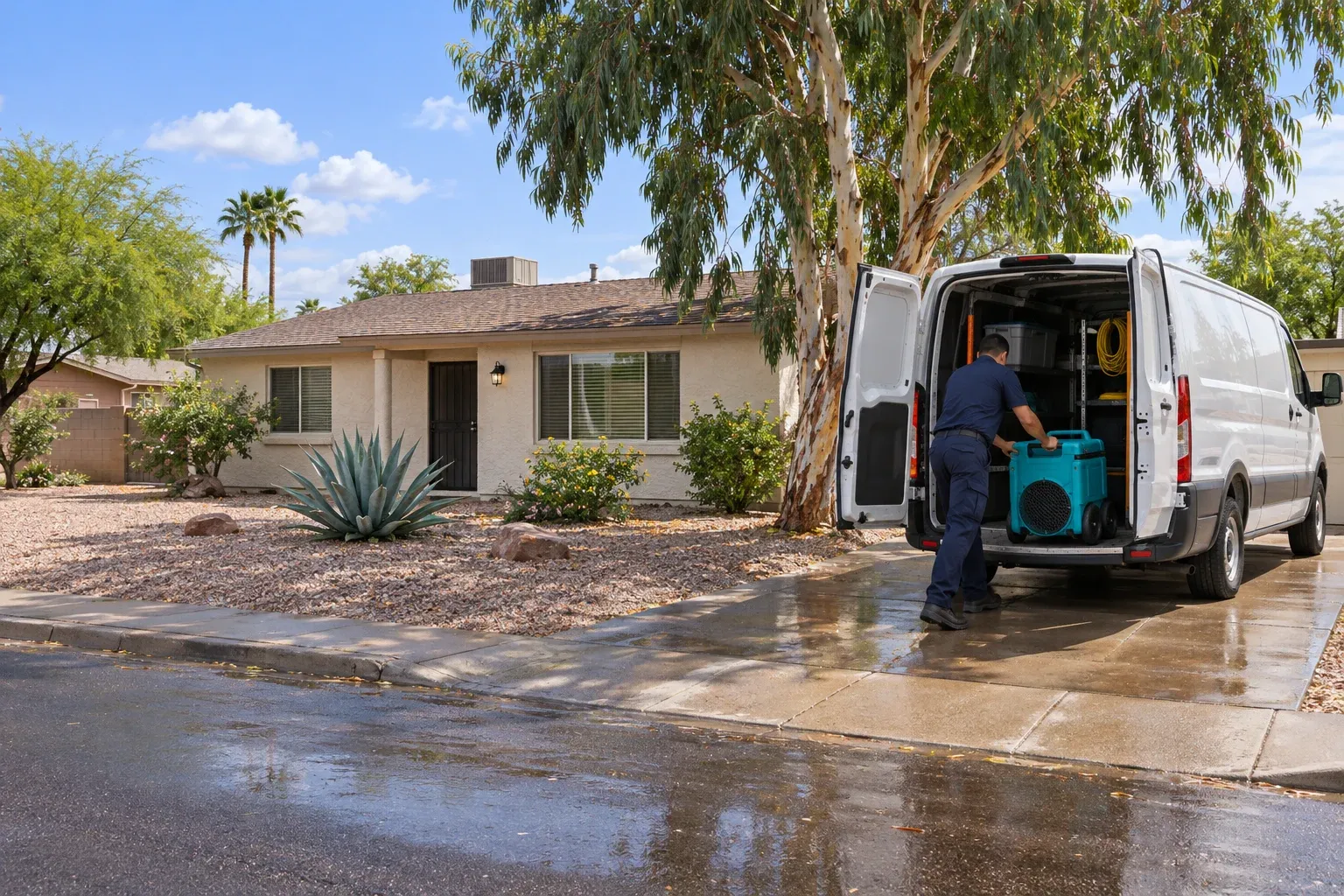
White cargo van with its rear doors open in a driveway, a man in navy work clothes wheeling a teal air machine out in front of a ranch house

Form open 24/7

Get a call back about mold in your home

Send the form. Someone from our team will call you back soon.

Mold in the house?Get a call back

Before you go: want a call back?

Send the request form and someone will call you back about the mold.

Get a call back

Get a call back

Send the form and someone from our team will call you back.